


“With this scientific activity it can increase the mobility of lecturers and postgraduate student to participate and present latest research in this international event. Furthermore the benefit of this conference is not just to broaden the horizon and increase the knowledge the participant, but also to establish cooperation and network between institution, researches, and presenters,” said Prof. Thyrhaya.


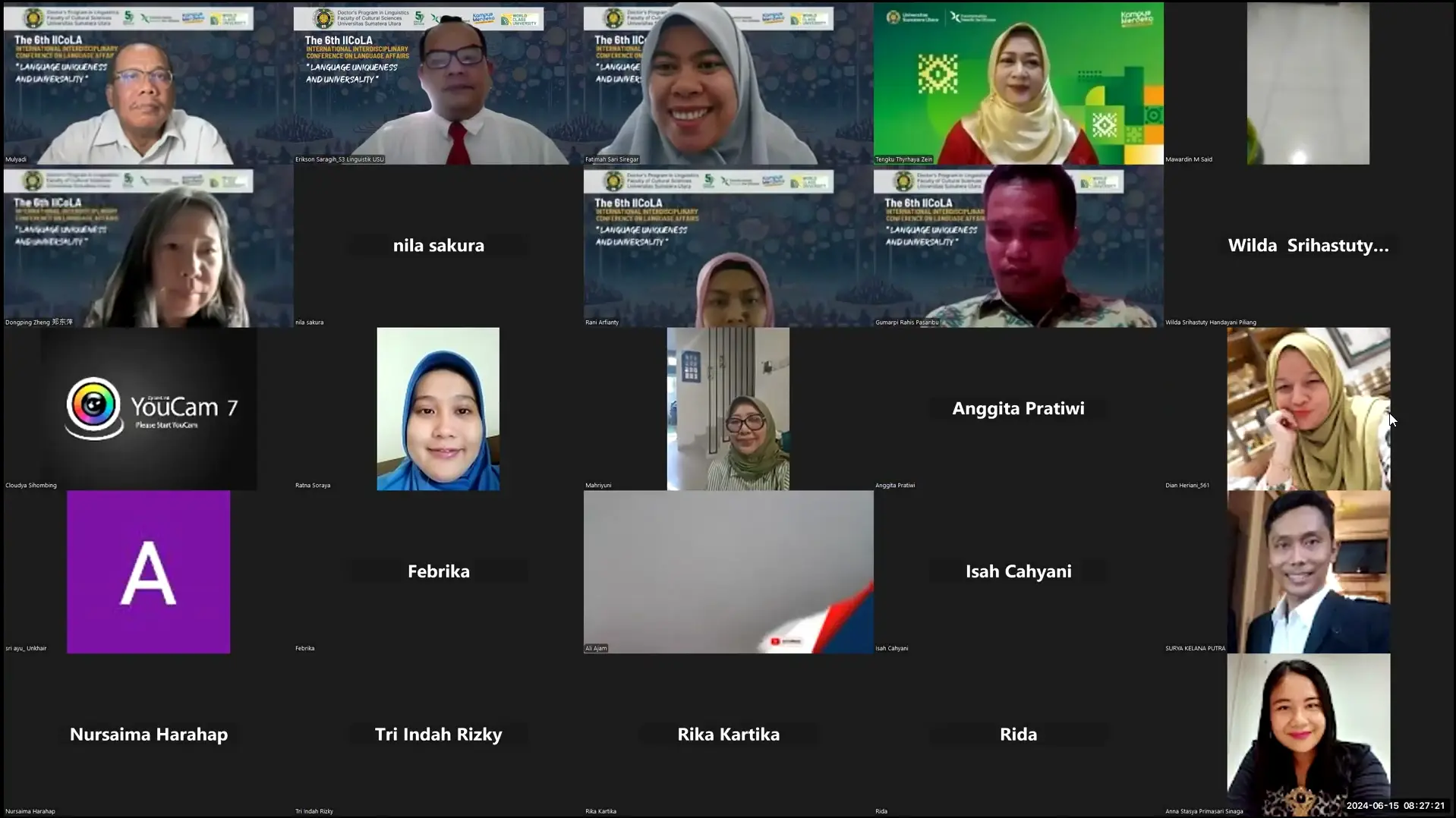
FIB USU PR - Saturday, June 15th 2024, Linguistics Doctoral Study Program of Faculty of Cultural Sciences Universitas Sumatera Utara, has carried out International Interdisciplinary Conference on Language Affairs (IICoLA). The conference invited several keynote speakers, which are Assoc Prof. Dongping Zheng, Ph.D. from University of Hawaii USA, Assoc Prof. Ayesha Junaid, Ph.D. from Christian University Pakistan, Assoc Prof. Saskia Van Viegen, Ph.D. from York University Canada, and Prof. Dr. Robert Sibarani, M.S. who is our Internal Lecturer. The conference was moderated by Dr. Erikson Saragih, S.Pd., M.Hum.

Head of FIB USU’s Linguistics Doctoral Study Program Prof. Dr. Drs. Mulyadi, M.Hum. thank the dean of FIB USU who have provided moral and financial support to the comitee, so this conference can be conducted. Prof. Mulyadi gives special thanks to Dr. Erikson who design this conference, and contacted the speaker so this event could take place, and also the doctoral students who organized this conference.
“I hope that this conference can strengthen the collaboration with the speakers personally and institutionally. In addition we hope that this implementation can support USU to become World Class University,” said Prof. Mulyadi.
Dean of FIB USU Prof. Dr. Dra. T. Thyrhaya Zein, M.A. in her speech said that the theme of this conference is very interesting. Language sis unique to humans for several reasons. Reflecting its complexity, versatility, and deep integration with human cognition and social attraction. Language universality refers to the features and principles that are commons across all human beings.
Prof. Thyrhaya wishes this conference will be a very productive conference with exciting and encouraging discussions and exchange of knowledge. So together we can anticipate a future ground breaking knowledge and research on language uniqueness and universality. Prof. Thyrhaya convey her highest appreciation and heartfelt thanks to rector of USU who support the annual conference of linguistic department.
“With this scientific activity it can increase the mobility of lecturers and postgraduate student to participate and present latest research in this international event. Furthermore the benefit of this conference is not just to broaden the horizon and increase the knowledge the participant, but also to establish cooperation and network between institution, researches, and presenters,” said Prof. Thyrhaya.
The first keynote speaker, Assoc Prof. Dongping Zheng, Ph.D. talks about her project, titled “Designing A Panda Virtual Reserve for Cross-cultural awareness and bilingual development”. This project is a collaboration with multiple people. The data collection and data analysis phase involve two of her Ph.D. students Michaela Cazares-nuesser, and Jin Dong. The goal of this project is to learn language through sense making: languaging and translanguaging, cultivate awareness of protecting the environment, becoming bilingually and bi-culturally sensitive through problem-solving, and develop perspective-taking.
The second keynote speaker Saskia Van Viegen, Ph.D. talks about her project, titled “Researching Translanguaging Practice with Children and Youth through School-based Fieldwork”. Saskia explains about what comprises a multilingual theory of language, what are students’ languaging practices, how do we implement translanguaging pedagogy, how can we cultivate a multilingual assessment ecology. One of the example from translanguaging pedagogy that she documented is student using language as a resource for mathematical thinking.
The third keynote speaker Prof. Ayesha Junaid, Ph.D. talks about her project, titled “An Analytical Study of Doctor-nurse-patient Communication to Improve Healthcare Practices in Lahore, Pakistan”. The objective of the study is to identify linguistic facilitators and barriers in communicative practices of healthcare professionals and patients, and to develop communication skills assessment tool to assess and evaluate communication skills of healthcare professionals in hospital settings. The data analysis has 4 phases. Phase 1 is semi-cultured interviews, which is transcriptions and coding of interviews. Phase 2 is video recordings, triangulation identification of additional barriers. Phase 3 is checklist development, content validity by delphi technique CVI, CVR, Kohen Kappa. Phase 4 is Observations, construct validity explanatory factor analysis and realibility by Cronbach Alpha.
The last keynote speaker Prof. Dr. Robert Sibarani, M.S. talks about Language uniqueness and universality from an anthropolinguistic perspective. The key points of anthropolinguistics on language uniqueness and language universality is focusing on the relationship between language and culture, examining how language shapes social life, cultural practices, and human cognition. And Exploring unique and universal aspects of language.