


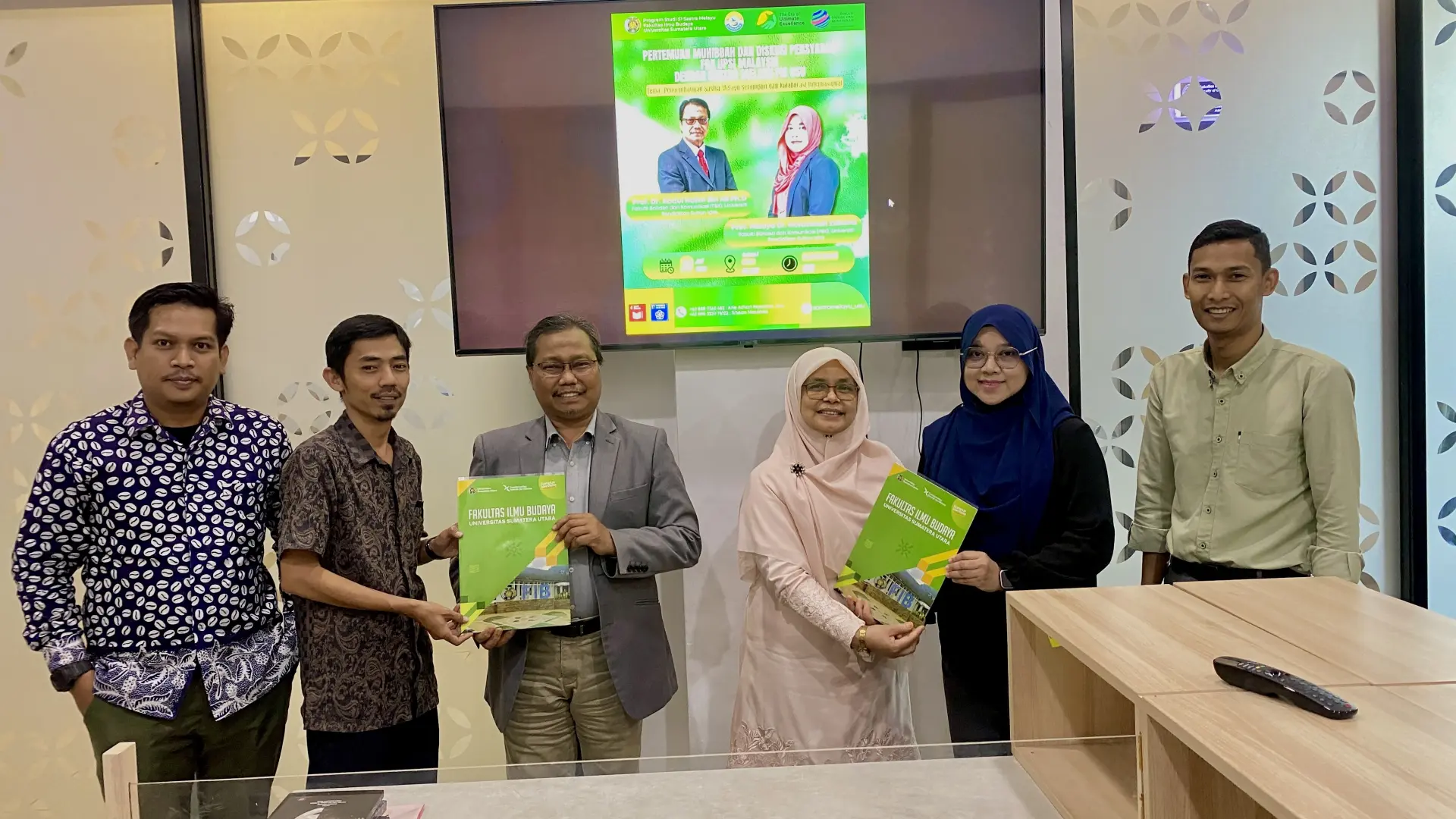
The Undergraduate Malay Literature Study Program of the Faculty of Cultural Sciences (FIB), Universitas Sumatera Utara (USU), held a Friendship Meeting and Discussion with lecturers from the Faculty of Languages and Communication (FBK), Universiti Pendidikan Sultan Idris (UPSI), Malaysia. The meeting, themed “Developing Malay Literature within the Malay World and International Collaboration,” was held on Thursday (July 30, 2026).
The meeting opened with remarks from Arie Azhari Nasution, S.S., M.A., Head of the Undergraduate Malay Literature Study Program, Faculty of Cultural Sciences, Universitas Sumatera Utara. He highlighted the future direction of the Undergraduate Malay Literature Study Program, particularly in expanding its international activities. This is considered increasingly important amid the decline in the number of new students enrolling in the program. He expressed his interest in collaborating with FBK UPSI Malaysia through activities encompassing the Three Pillars of Higher Education (Tri Dharma Perguruan Tinggi) as a means of strengthening the program's recognition at the university level.
The Undergraduate Malay Literature Study Program also seeks to increase its student enrollment, particularly by attracting international students to study in the program. As the only undergraduate Malay Literature study program in Indonesia, this uniqueness represents one of its key strengths.
One strategy proposed to increase new student enrollment is to produce and disseminate more publications and videos through social media. This approach is considered important because the Undergraduate Malay Literature Study Program remains relatively unfamiliar to the wider public, particularly among middle- and upper-income communities.
“Future activities will include joint research with overseas universities, international lecturer and student exchanges, scientific publication collaborations, and strengthening academic networks at the international level. Beautifully woven fabrics embody the noble heritage of our ancestors; let us unite to advance literature so that Malay culture will continue to flourish,” said Arie.
The meeting continued with remarks from Dra. Mardiah Mawar Kembaren, M.A., Ph.D. She explained that earlier that morning, a Memorandum of Agreement (MoA) had been signed directly by representatives of USU and UPSI at the USU Rectorate Office. The meeting also discussed the Indonesia-Malaysia-Thailand Growth Triangle (IMT-GT). Based on these discussions, she said, various future activities related to the Malay world could be developed, including student seminars, mobility programs, and other collaborative initiatives.
“The Undergraduate Malay Literature Study Program may be small in number, but it is large in impact,” said Mardiah.
Prof. Dr. Abdul Halim Bin Ali, Ph.D., the first speaker, emphasized the importance of strengthening social media communication. He explained that his institution has a dedicated reporter who ensures that activities are documented and uploaded to social media on the same day.
“Social media must be strengthened. Visualize every activity carried out so that the information reaches the wider public, while also introducing Malay Literature to students who are still in school,” said Prof. Halim.
Prof. Halim outlined various programs that could be implemented collaboratively, including student exchanges, student mobility programs, credit transfer programs, summer and winter programs, academic visits, and the organization of seminars and conferences. Lecturer exchange opportunities could also be developed through both short- and long-term programs, as well as expertise-based training, visiting and guest professors, internships, sabbaticals, and academic or non-academic mobility.
One example of an existing collaboration was the International Field Work Program for students of the International Class Program (ICP) at the Faculty of Tarbiyah and Teacher Training (FITK), UIN Walisongo Semarang, with UPSI.
Prof. Halim also recommended improving the quality of teaching and learning, strengthening international research collaborations, producing joint publications, expanding global academic networks, creating opportunities for research grants, supporting the transfer of knowledge, technology, and best practices, enriching lecturers' experiences through exposure to new perspectives and expertise, strengthening recognition for faculty and university rankings, and increasing the international visibility of faculties and universities.
The Undergraduate Malay Literature Study Program has previously implemented a World-Class University initiative through the Regional Student Seminar on Malay Literature, which invited Prof. Halim as the keynote speaker and Dr. Yabit Alas from Universiti Brunei Darussalam as a guest lecturer and accompanying faculty member.
Prof. Halim also introduced the International Seminar on Research in Education, Culture, and Regional Mobility (ISERCREM 2.0), which was jointly organized with UIN Walisongo Semarang and the Persatuan Penulis BUDIMAN Malaysia. He proposed that ISERCREM 3.0 could be organized in collaboration with USU.
As the second speaker, Prof. Madya Dr. Norazimah Zakaria provided an overview of the Faculty of Languages and Communication at Universiti Pendidikan Sultan Idris, including its academic structure, programs, courses, and credit-hour system. The presentation was intended to facilitate the alignment of courses and credits with those offered by the Faculty of Cultural Sciences at USU, particularly the Undergraduate Malay Literature Study Program, as a foundation for future collaboration between the faculties and universities.