


In this context, the theme "English and Related Studies in the World: Future Possibilities, Transformation & Innovation" becomes very relevant. This theme invites academics, researchers and practitioners to discuss the future direction of English studies and how we can harness innovation to overcome global challenges.


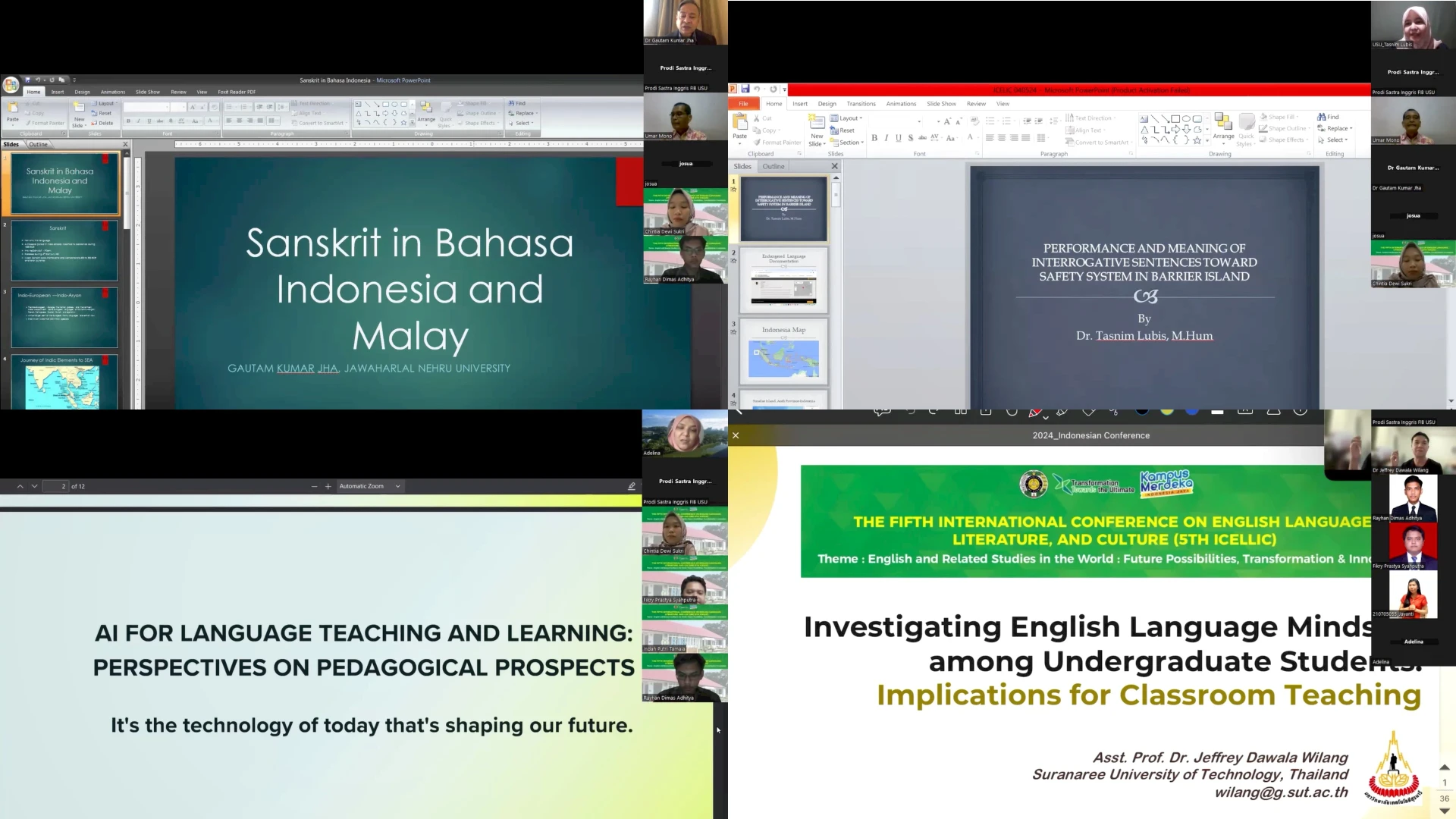
FIB USU PR - Saturday, May 4th 2024, the Undergraduate of English Literature and Postgraduate of English Study Program, Faculty of Cultural Sciences (FIB), Universitas Sumatra Utara (USU) held the fifth International Conference on English Language, Literature, and Culture (ICELLIC) via Zoom Meeting. The seminar also invited external speakers, including Prof. Gautam Kumar Jha, Ph.D. from Jawaharlal Nehru University, Prof. Dr. Adelina Asmawi from the University of Malaya, Prof. Dr. Anamel Damnet from Kasetsart University and internal speaker Dr. Tasnim Lubis, M. Hum.
In an era of globalization and rapid technological progress, English studies and related fields are experiencing significant transformation. These developments not only affect the way we learn and teach English, but also how we understand the role of the language in a global context. Throughout the world, English has become the main means of communication in various sectors, from education, business, to diplomacy. Therefore, understanding the dynamics and innovations in English studies is very important to answer future challenges.
Technological advances, such as artificial intelligence, machine learning and digital platforms, have opened up new opportunities in English language teaching and learning. This technology allows for more interactive, adaptive and personalized learning methods. In addition, globalization has encouraged the emergence of multicultural and cross-disciplinary approaches in the study of English. Thus, there is an urgent need to explore possible transformations and innovations in this field to ensure its relevance and effectiveness in the future.
On the other hand, global challenges such as climate change, social inequality, and political conflicts also affect the study of English. English is not only a means of communication, but also a medium for influencing public opinion, policy and global culture. Therefore, it is important to explore how English studies can adapt and contribute to facing these challenges.
In this context, the theme "English and Related Studies in the World: Future Possibilities, Transformation & Innovation" becomes very relevant. This theme invites academics, researchers and practitioners to discuss the future direction of English studies and how we can harness innovation to overcome global challenges. In this way, we can build a strong foundation for the teaching, research and application of English in the future.