


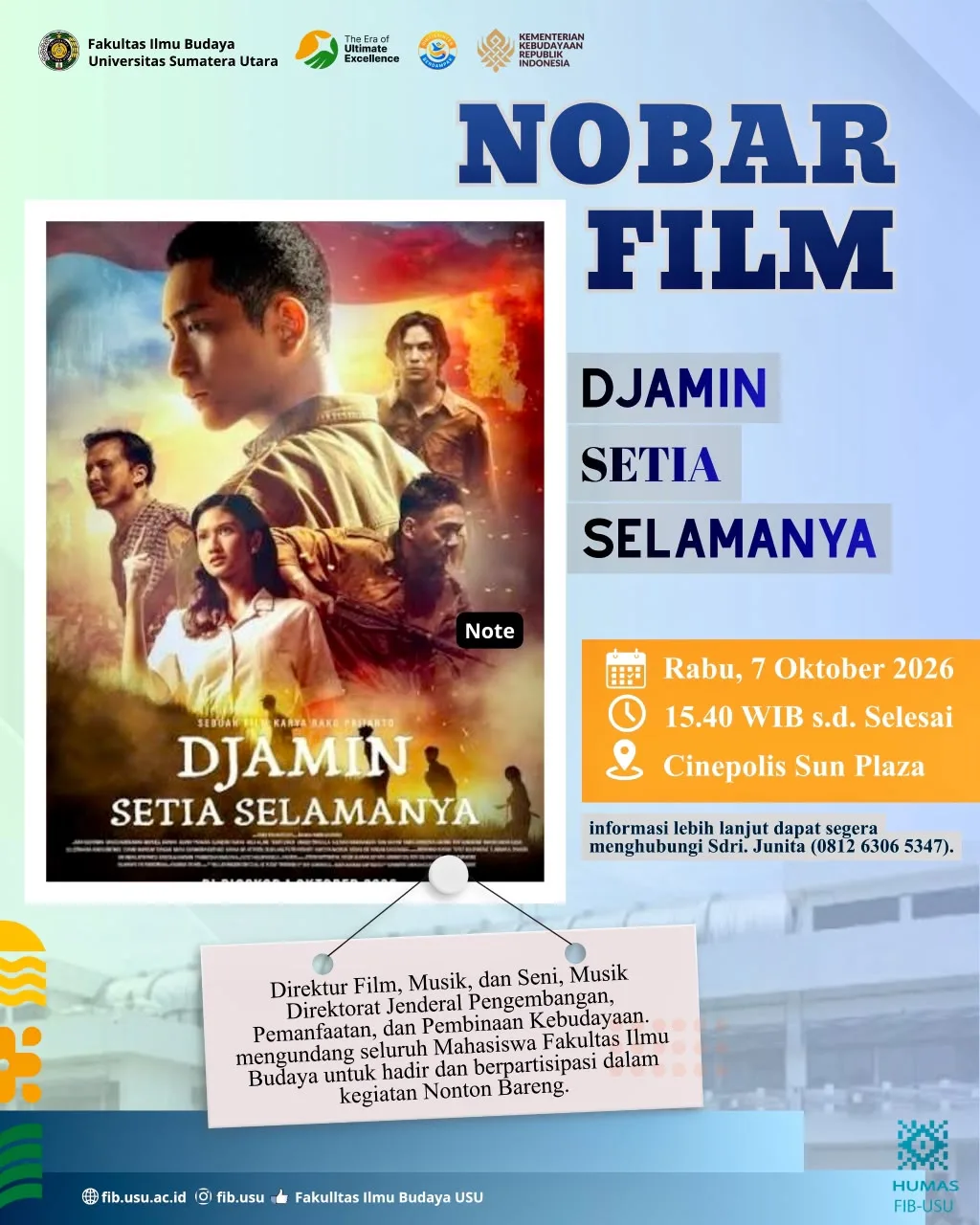
FIB USU PR - on Wednesday October 7, 2026 The Indonesian Ministry of Culture reaffirmed its commitment to supporting the production of films about national heroes as a means of promoting historical education and fostering patriotism among younger generations. This commitment was conveyed by Irini Dewi Wanti, S.S., M.S.P., Director of Film, Music, and Arts at the Ministry of Culture of the Republic of Indonesia, during an interactive dialogue and screening of Djamin Setia Selamanya at Cinepolis Sun Plaza, Medan.
During the event, Irini Dewi Wanti explained that films about national heroes have considerable potential to communicate historical knowledge while inspiring Generation Z and Generation Alpha to understand the meaning of struggle, sacrifice, leadership, and loyalty to the nation.
“The meaning of struggle, the meaning of sacrifice, and loyalty to the nation remind us that independence was not a gift,” she stated.
She added that, following the direction of the Minister of Culture, the Ministry was supporting the production of films featuring national figures and heroes from various regions of Indonesia, from Aceh to Papua. The initiative included seven feature-length films and 13 short films focusing on heroism. One of the figures being portrayed is General Hoegeng. These productions are expected to broaden public access, particularly for younger generations, to stories about the struggles and contributions of the nation's heroes.
Furthermore, Irini emphasized that support for films about national heroes also extended to the post-production stage to help these works reach wider audiences. Through film, young people are expected not only to become familiar with historical figures but also to understand and share the values of struggle and dedication embodied by these individuals.
The Dean of FIB USU, M. Pujiono, S.S., M.Hum., Ph.D., stated in his remarks that Djamin Setia Selamanya reminds the public of the importance of courage, leadership, and patriotism. He emphasized that history should not merely be remembered but also understood so that its values can serve as meaningful lessons for present and future generations.
“History is not merely something to be remembered, but something to be understood,” he remarked.
Meanwhile, Prof. Dr. Drs. Suprayitno, M.Hum., Ph.D., one of the authors of the book Djamin Setia Selamanya, explained that the work was inspired by Djamin Ginting, whose life reflected loyalty to his country, family, and education. One of the important values highlighted in the book was his commitment to education, even amid the hardships of war and displacement.
“Although he fought against the Dutch, he also established a school for children in refugee camps,” he explained.
Suprayitno also stressed the importance of academic involvement in communicating historical information to the public. According to him, film is an effective medium for conveying knowledge, including academic research. However, when historical information is adapted into popular works, factual accuracy must remain a priority to prevent public misunderstanding.
The event was also attended by the Dean of FIB USU, M. Pujiono, S.S., M.Hum., Ph.D.; the Organizing Committee Chair, M. Azis Rizky Lubis, S.S., M.A.; members of the writing team behind Djamin Setia Selamanya, namely Prof. Dr. Drs. Suprayitno, M.Hum., Ph.D., Dr. Drs. Edi Sumarno, M.Hum., and Dra. Junita Setiana Ginting, M.Si.; as well as members of Djamin Ginting's family.
Through the interactive dialogue and screening of Djamin Setia Selamanya, the event is expected to strengthen historical awareness, increase appreciation for national heroes, and encourage the use of film as a medium for teaching history and culture in ways that resonate with younger generations. Collaboration between the government and academic institutions also represents an important step toward ensuring that historical narratives shared with the public remain inspiring, educational, and responsible.