


"With this collaborative activity, students can build networks and professional collaboration in the library domain and introduce Indonesian culture to foreign countries, especially those who have collaborated in this collaboration. "Furthermore, it is hoped that this collaborative activity can build a broad professional and academic network, which can be useful for future careers and further research collaboration," said Muhammad Rasyid Ridlo, S. Hum., M.I.Kom.


FIB USU PR - Wednesday, May 29th 2024, Students from the Library and Information Science Study Program, Faculty of Cultural Sciences (FIB), Universitas Sumatra Utara (USU), Stambuk 2022, held collaborative activities with several Asian countries. This collaborative activity was attended by countries from Southeast Asia, East Asia and West Asia such as "Malaysia", "Brunei Darussalam", "South Korea", and "Yemen".
This activity was carried out to fulfill the mid-semester exam in the Network Systems and Library Collaboration course. This activity was guided by Muhammad Rasyid Ridlo, S.Hum, M.I.Kom as a lecturer in the Network Systems and Library Collaboration course. The output resulting from collaboration in the Network Systems and Library Cooperation course is introducing Indonesian culture to other countries, improving students' skills in collaborate with other parties in a professional manner, including language skills, cross-cultural knowledge, and practical experience in a global environment.
In this collaborative activity, students are divided into several groups. Of the entire group, several groups with the following names succeeded in holding this collaborative activity. Here is the list:
Queens College Kuala Lumpur, Malaysia. Title/Topic Libraries and Information Literacy:
- Bambang Sugiarto (leader)
- Aura Adisty Lesmana
- Tazya Margaterha Sitohang
- Indriyani
Universiti Kuala Lumpur-Malaysia France Institute, Malaysia. Title/Topic Digging into Malay Culture in The City of Medan, North Sumatera:
- Yla Trifani (leader)
- Jenny Hartati
- Muthia Sari
- Rafika Husna
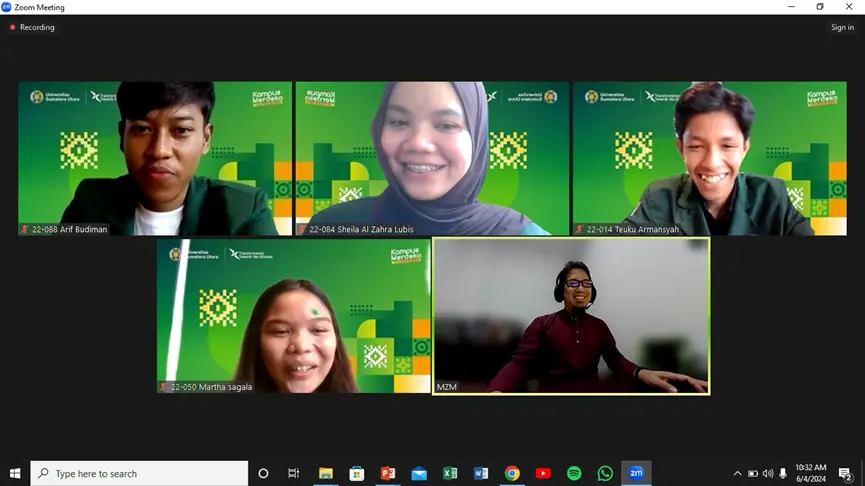
Kolej International Graduate Studies, Brunei Darussalam. Title/Topic Literacy Culture of Reading and Writing:
- Martha Olivia Sagala (leader)
- Arif Budiman
- Sheila Al Zahra Lubis
- Teuku Armansyah
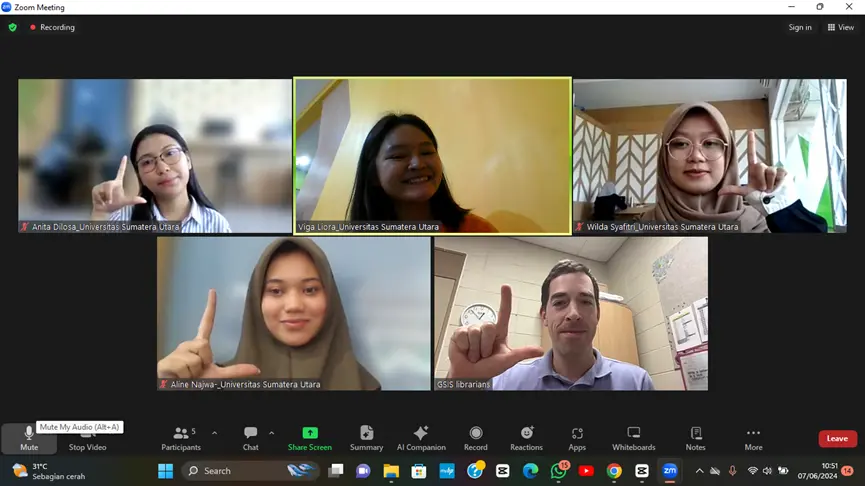
Gyeonggi Suwon International School, Korea Selatan. Title/Topic Preservation and Conservation of Library Collection:
- Wilda Syafitri (leader)
- Viga Liora Ateta Tarigan
- Anita Dilosa Br. Ginting
- Aline Najwa Pelumi Siregar
Akademi Bahasa An-Nama Ar-Riyadah, Yaman. Title/Topic The Allure of North Sumatera:
- Athaya Yumna Fitria (leader)
- Humairah Hunaifiyah Al-Layalin Manik
- Jihan Sajidah
- Mudrika Nabila
"With this collaborative activity, students can build networks and professional collaboration in the library domain and introduce Indonesian culture to foreign countries, especially those who have collaborated in this collaboration. "Furthermore, it is hoped that this collaborative activity can build a broad professional and academic network, which can be useful for future careers and further research collaboration," said Muhammad Rasyid Ridlo, S. Hum., M.I.Kom.
Muhammad Rasyid Ridlo advised students to continue to explore their best potential. The potential of each student in the future can be useful for the library, which of course will be felt by the community.