


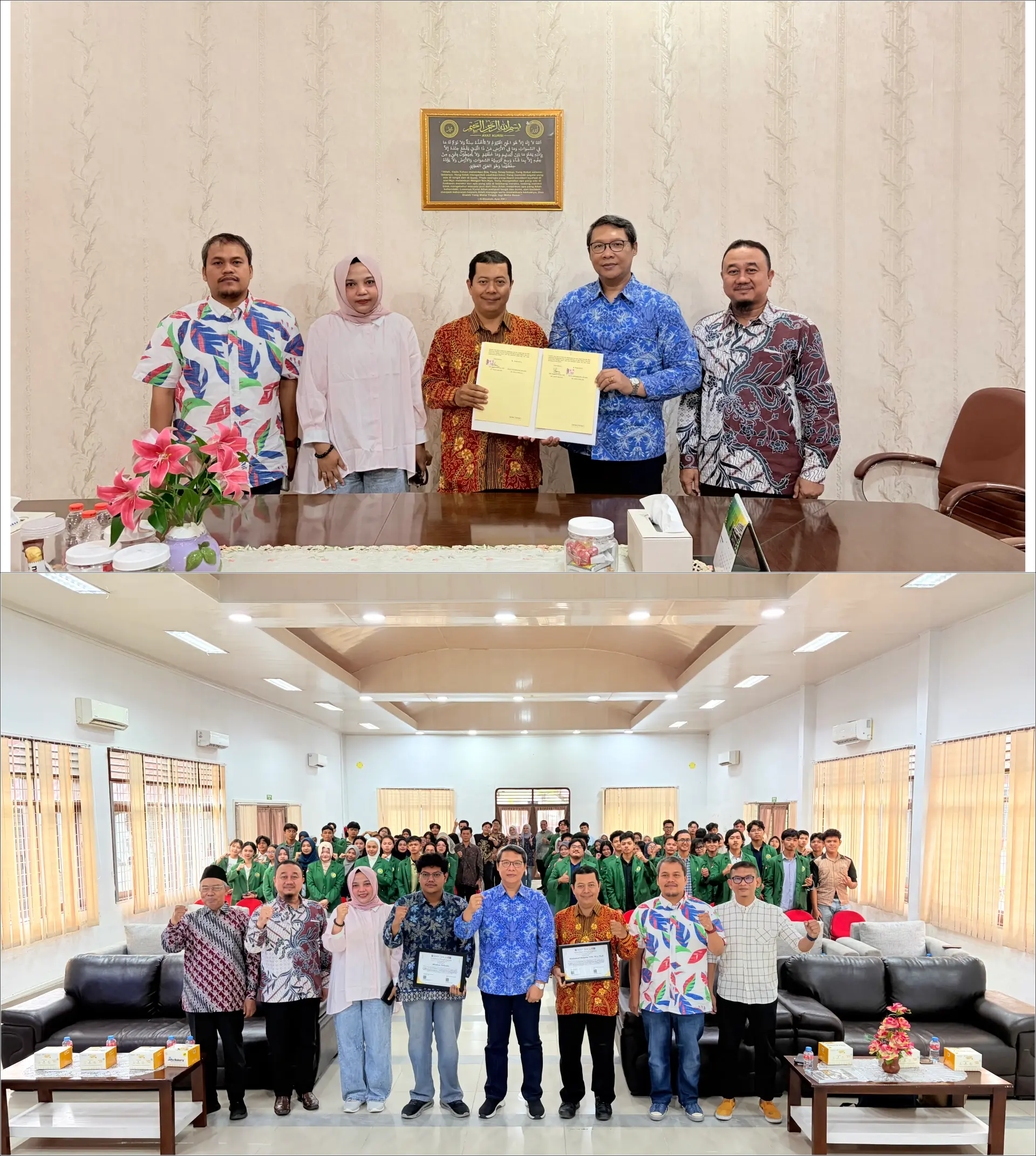
FIB USU PR - On Friday, September 18, 2026, the Undergraduate History Program at the Faculty of Cultural Sciences (FIB), Universitas Sumatera Utara (USU), held a public lecture entitled “Oral History in the Digital Era.” The event featured Mukhamad Shokheh, S.Pd., M.A., Ph.D., a lecturer in the History Program at the Faculty of Social and Political Sciences (FISIP), Universitas Negeri Semarang (UNNES), as the guest speaker.
The public lecture provided an academic forum for students to explore the development of oral history amid the ongoing digital transformation. In his presentation, Mukhamad Shokheh emphasized that oral history should not be understood merely as the recording of interviews, but rather as a process of collecting, critically examining, processing, and preserving memory as a historical source.
Advances in digital technology have created new opportunities for the practice of oral history. Various media, including podcasts, videos, online interviews, and digital archives, can be utilized to document and disseminate historical sources to a broader audience.
The development of Artificial Intelligence (AI) also offers opportunities to support historical research, particularly in interview transcription and data management. However, the use of technology must be accompanied by verification, source criticism, and authentication to ensure the academic validity and reliability of the information produced.
In this context, students play an important role in advancing digital oral history. They are encouraged not only to conduct interviews within communities but also to process and authenticate transcripts, curate historical sources, and transform research findings into various forms of digital historical products.
These products may include podcasts, documentary films, virtual exhibitions, and digital historical narratives. The use of diverse digital platforms provides students with opportunities to present history in formats that are more contextual, creative, and accessible to the public.
The public lecture also served as an opportunity to strengthen institutional relations between FIB USU and FISIP UNNES through the signing of a Memorandum of Agreement (MoA). In addition, an Implementation Agreement (IA) was signed between the Undergraduate History Program at FIB USU and the History Program at FISIP UNNES.
The agreements represent an effort to expand academic networks and create opportunities for collaboration between the two institutions, particularly in education, research, and academic activities in the field of history.
The collaboration is expected to provide broader opportunities for faculty members and students to exchange knowledge, develop academic competencies, and undertake collaborative initiatives that contribute to the advancement of historical studies.
Through this activity, the Undergraduate History Program at FIB USU not only strengthens students’ understanding of oral history methods but also encourages them to adapt to technological developments in historical research and the dissemination of historical knowledge.
The integration of academic competencies with digital technology is expected to equip history students with the capacity to develop, preserve, and present historical memories through diverse formats that remain relevant to the changing digital landscape.