


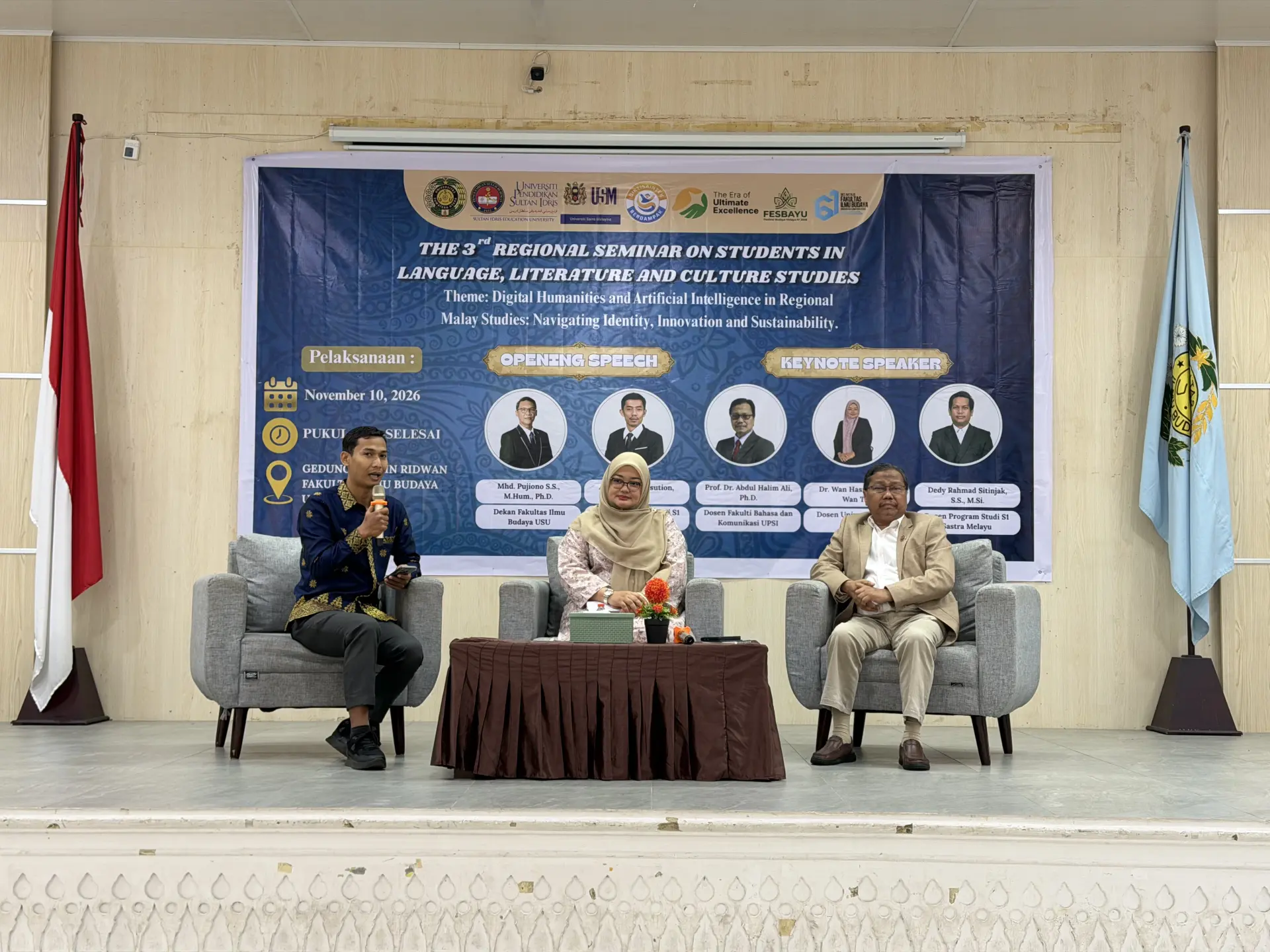
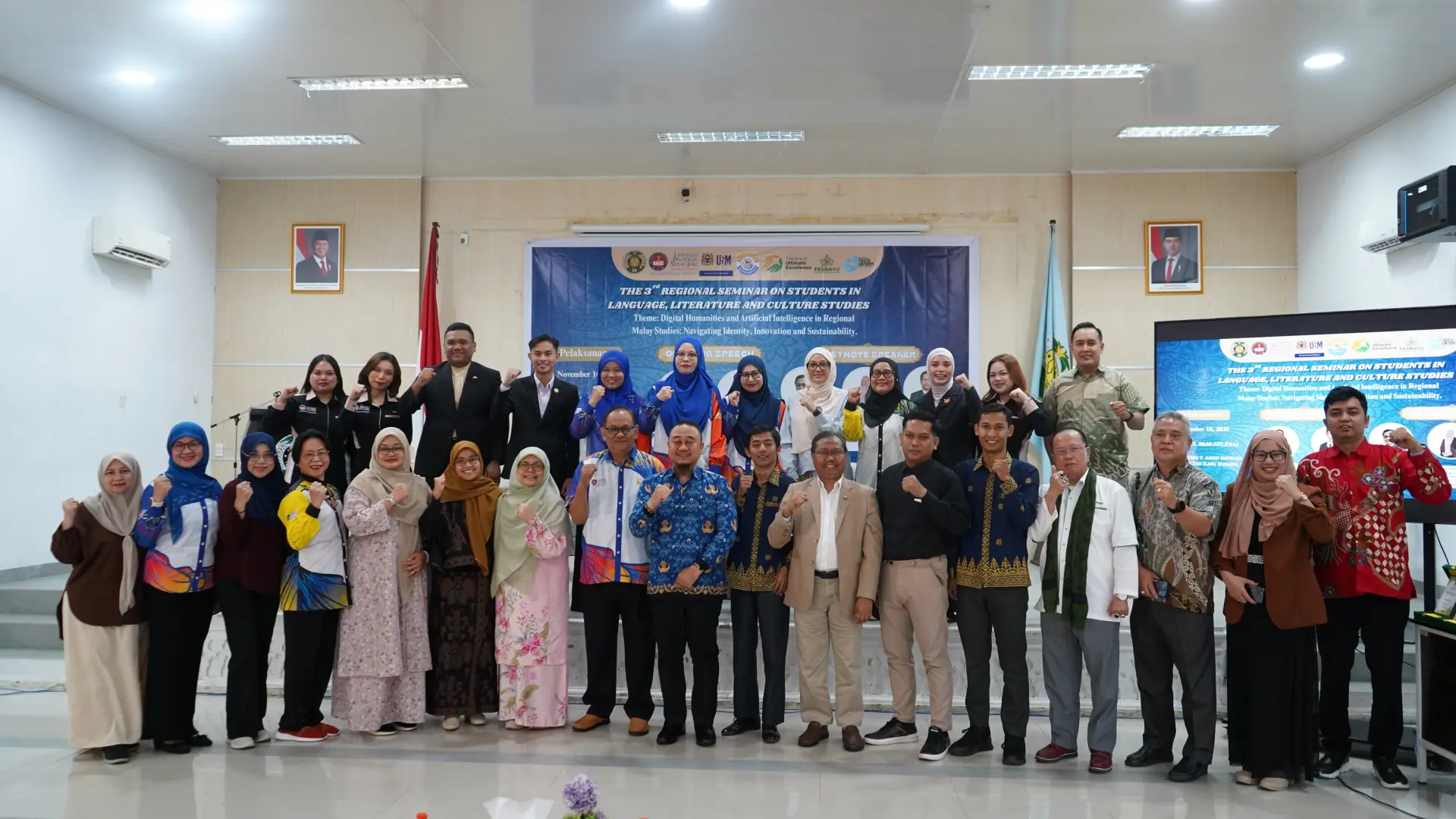
In celebration of the 61st anniversary (Dies Natalis) of the Faculty of Cultural Sciences (FIB) at the Universitas Sumatera Utara (USU), the Undergraduate Program in Malay Literature hosted the 3rd Regional Seminar on Students in Language, Literature, and Culture Studies. The seminar, themed "Digital Humanities and Artificial Intelligence in Regional Malay Studies: Navigating Identity, Innovation, and Sustainability," took place on Tuesday, November 10, 2026.
Aligned with SDG 17 (Partnerships for the Goals), this 3rd Regional Seminar was organized through a collaboration between the Bachelor’s Degree Program in Malay Literature at FIB USU and the Malay Literature Program at the Faculty of Languages and Communication (FBK), Universiti Pendidikan Sultan Idris (UPSI), Malaysia. The event was attended by Andi Pratama Lubis, S.S., M.Hum.—representing the Dean of FIB USU in his capacity as Vice Dean for Research, Community Service, Cooperation, and Internationalization—along with the Head of the Bachelor’s Degree Program in Malay Literature at FIB USU, Arie Azhari Nasution, S.S., M.A., as well as various speakers from universities across Indonesia and Malaysia, and administrative staff from FIB USU.
The keynote speakers for this seminar include Prof. Dr. Abdul Halim Ali, Ph.D., a professor from FBK UPSI; Dr. Wan Hasmah binti Wan Teh, a lecturer from Universiti Sains Malaysia; and Dedy Rahmad Sitinjak, S.S., M.Si., a lecturer from the Undergraduate Program in Malay Literature at FIB USU.
Prayogo, S.S., M.Si., serving as the chair of the organizing committee, expressed his deepest gratitude to all parties who provided support, whether in material or non-material forms. He noted that the event features approximately 30 presenters from various institutions. "As the chair of the organizing committee, I wish all participants a productive seminar. I hope you take this opportunity to exchange ideas, expand your knowledge, and grow your professional network," said Prayogo.
In his remarks, the Head of the Bachelor’s Program in Malay Literature stated that the theme, "Digital Humanities and Artificial Intelligence in Regional Malay Studies: Navigating Identity, Innovation, and Sustainability," represents a crucial and strategic moment for us all. Amidst the tide of globalization, we cannot afford to remain passive. Aligning with SDG 4 (Quality Education), the emergence of digital technology and artificial intelligence should not be viewed as a threat to the existence of traditions; rather, it serves as a golden opportunity for the revitalization and preservation of regional cultural heritage, while simultaneously broadening the reach of cultural research. Navigating Malay identity in an era of digital innovation—without losing the foundations of sustainability—is an intellectual challenge that we must address collectively through this scholarly forum.
“Through cross-institutional and cross-national collaboration—involving the Universitas Sumatera Utara, Universiti Pendidikan Sultan Idris, Universiti Sains Malaysia, and other institutions—we hope this seminar will generate fresh ideas, new methodologies in Digital Humanities, and stronger research networks, all aimed at advancing Malay civilization on the global stage,” stated Arie.
The first keynote speaker, Dr. Wan Hasmah binti Wan Teh, presented on the topic, “The Transformation of Regional Malay Heritage within the Contemporary Research Landscape.” She explained that the transition of regional Malay cultural heritage—from traditional manuscripts to the digital era and contemporary media—has brought significant changes, not only regarding access and preservation but also in the construction of meaning and scholarly responsibility. This discussion highlighted the importance of integrating classical philology with digital humanities and artificial intelligence—a process that must remain grounded in meticulous human interpretation and research ethics that respect the rights of local communities. Through a comprehensive framework, researchers are reminded that the use of modern technology should not merely homogenize cultural uniqueness; rather, it should serve as a tool for preservation that strengthens academic integrity while safeguarding the authenticity of Malay knowledge traditions amidst the currents of globalization.
The second keynote speaker, Prof. Dr. Abdul Halim Ali, Ph.D., addressed the topic, “The Role of Higher Education Students in the Development and Advancement of Regional Literary Studies.” He explained that students must engage in understanding, evaluating, and interpreting literature. As creators—writing poetry, short stories, novels, plays, creative essays, and digital works—students become an integral part of the literary development process. Furthermore, through academic mobility and networking—facilitated by student exchange programs, conferences, seminars, workshops, and collaborative projects—students from various countries can be brought together.
Dedy Rahmad Sitinjak, S.S., M.Si., serving as the third keynote speaker, presented a topic titled "The Representation of Cultural Identity through Diverse Meanings and Rhetorical Functions in the *Pantun* (Poetic Verse) Exchange Tradition within Malay Traditional Wedding Ceremonies." The tradition of exchanging *pantun* during traditional Malay weddings is more than just a poetic embellishment; it is a dynamic social act used to govern interactions and affirm cultural identity. The *pantun* verses analyzed in his study represent eight domains of identity—ranging from the legitimacy of communication, the diplomatic protocol of the *sirih pinang* (betel nut) offering, and family norms, to maritime space and gender negotiations—while also serving rhetorical functions such as building consensus, managing the stages of traditional rituals, and easing the atmosphere through humor. This study demonstrates that the *pantun* functions as a verbal art form rich in social communication strategies.
Concurrently, the seminar featured presentation sessions organized into several panels, held in the multipurpose building, rooms O.103 and O.104, and the meeting room within the FIB USU building. There were six panels in total, with an average of four presenters per panel. The presenters hailed from various institutions, including Universitas Prima Indonesia, Universitas Muhammadiyah Sumatera Utara, Universiti Utara Malaysia, Sultan Idris Education University, Universiti Sains Malaysia, and others.