


"We hope to be able to exchange FIB USU students with Prince of Songkla University Thailand. We also hope that next semester students will be able to study at PSU, Thailand. Then we can also invite students to join the Summer Course activities by FIB USU. This year, we will invite the dean of PSU, Thailand to join and be funded by USU," said the Dean of FIB USU.


FIB USU PR - On Thursday, February 29th, 2024, the Master of Historical Science Study Program, Faculty of Cultural Sciences (FIB), Universitas Sumatra Utara (USU) received a visit from Prince of Songkla University (PSU) to give a public lecture and signing of the MOA/IA as well as artistic offerings from 2 countries, both Indonesia and Thailand. This public lecture was led by the head of the Master of Historical Science study program, Prof. Pujiati M.Soc.Sc Ph.D. On the occasion of the public lecture, Starting with welcoming remarks to PSU by Prof. Pujiati M.Soc.Sc., Ph.D., followed by welcoming remarks and an official opening by the Dean of FIB USU Prof. Dra. T. Thyrhaya Zein, M.A. and continued by PSU Prof. Madya Nurman.

This activity was carried out with the support of Dean of FIB USU Prof. Dr. T. Thyrhaya Zein, M.A. and Vice Dean Dra. Heristina Dewi M.Pd. and Mhd Pujiono S.S., M.A., Ph.D. who were present both materially and morally to help carry out this event so that it could be coordinated and run well. Then the PSU group consisted of 4 PSU lecturers, namely Prof. Madya Dr. Nurman Hayimasae, Dr. Sawawee Padaamen, Dr. Munirah, Prof. Madya Dr. Faisol Haji Awang and 25 students from PSU Thailand. Participants in this public lecture consisted of 130 people and were also attended by 4 Heads of Study Programs and Secretary of Study Programs within USU's FIB (S1 Historical Science, Arabic Literature, Malay Literature, Indonesian Literature and Ethnomusicology) and USU lecturers.
Dean of FIB USU Prof. Dr. Dra. T. Thyrhaya Zein M.A. in her remarks, hoped that today's meeting could produce good results for lecturers and students as well. Currently FIB USU supports USU in terms of being a World Class University. The Dean of USU FIB wants PSU to join in studying the culture of North Sumatra, which has a variety of cultures. The aim of this lecture is to contribute to strengthening the internationalization programs of both universities.
"We hope to be able to exchange FIB USU students with Prince of Songkla University Thailand. We also hope that next semester students will be able to study at PSU, Thailand. Then we can also invite students to join the Summer Course activities by FIB USU. This year, we will invite the dean of PSU, Thailand to join and be funded by USU," said the Dean of FIB USU.
This activity has an important meaning for cooperation in the field of Tridharma of Higher Education. PSU is the first university in southern Thailand, founded in 1967. The name of the University was given by King Bhumibol Adulyadej in honor of Prince Mahidol Adulyadej, Prince of Songkla. The aim of this activity is to pioneer cooperation in the fields of Tridharma, Education, Service and Research between the two parties, namely USU and PSU, as well as academic friendship with public lecture activities which will be delivered by Asoc. Prof. Dr. Faisol Haji Awang and moderated by the secretary of the Master of History study program, Drs. Nuhung M.A Ph.D. Public lecture with the theme "Islamic Influence in Pattani Culture".
We hope that this activity can be continued again with a return visit from USU to PSU or the acceptance of foreign students from Thailand interested in continuing their studies in the Master's program in Historical Science at FIB USU and we are also invited to give public lectures and research and service collaborations in the future.
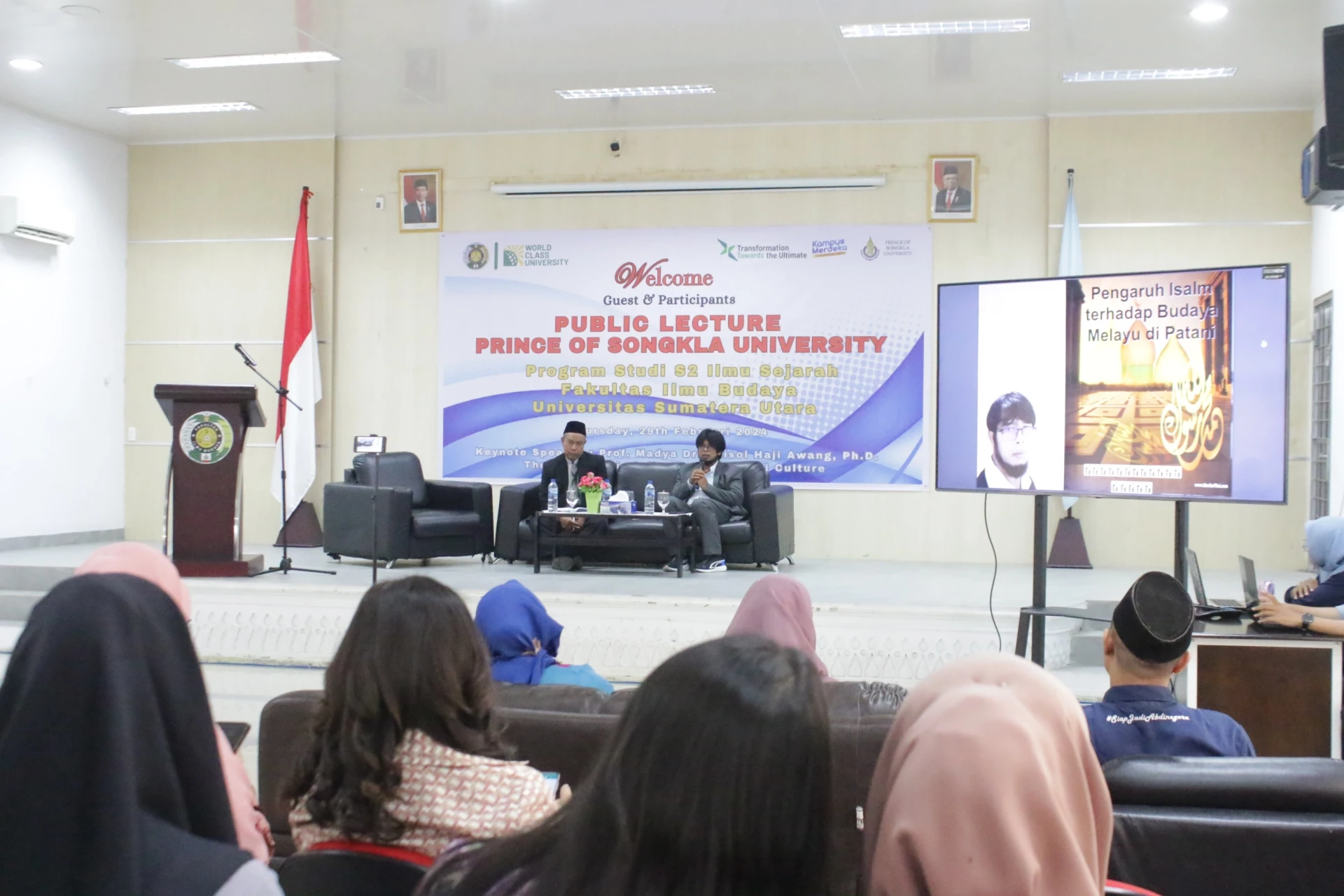
In his presentation, Prof. Madya Faisol Haji Awang, Ph.D. explained that Islam is a universal religion so that in the process of its spread it has been widely welcomed in society from the classical to the modern era. Regarding the relationship between Islam and Malays in Pattani, Prof. Madya Faisol said it was something strong. So, in the relationship between religion and ethnicity it is often said: Malay is Islam and Islam is Malay. Islamic symbols can be seen in Pattani culture in places of worship, Muslim clothing, halal food, Islamic weddings, friendship between Muslims and other groups and with other countries and so on. This relationship is then strengthened by the existence of surau or Pondok-based educational institutions that are developing. rapidly in Pattani and other areas of southern Thailand. Until now, the Malay people in Southern Thailand, who are geographically very close to Malaysia, still adhere to these Malay values as their way of life.
The relationship between Thai Malays and Indonesian Malays in terms of regional culture and Islam, namely in the border area, Pattani is often nicknamed Changwad Chaiden Pak Thai where most of those living in the area are Muslim. In this area there are four provinces, namely Yala, Narathiwat, Pattani and Satun where the people there mostly adhere to Islam. The beginning of the Pattani kingdom was led by Sultan Sulaiman who came from Aceh because initially Pattani was a sovereign kingdom where most of the inhabitants were Malay-based people and was located in the southern part of Thailand.
Malay Muslims are a minority group who live in the Pattani area, one of whose provinces is located in southern Thailand. Islam and Malay culture are united and inseparable, therefore there are several cultures that are closely attached and make it a characteristic feature of the Pattani Muslim Malays in the southern part of Thailand. This culture includes:
- Malay Muslims are citizens of Thailand, but the majority of Malay Muslims speak Malay. If you listen to Indonesian people, it may be difficult to understand what they are saying when they are speaking quickly. But if they speak slowly there will be some similarities between Indonesian combined with Malaysian Malay. From a linguistic and cultural perspective, the Pattani Malay Muslims are very close to the Kelantan Malays in Malaysia, because the Kelantan Malays from a geographical perspective is very close to the Pattani area, and historically they are descendants of the same kingdom or sultanate in the 5th century.
- The Malay Muslim community uses Malay Arabic letters when writing. In fact, the Thai government or kingdom has ordered them not to use Arabic writing culture, but they don't want to use Thai writing because they think that it will eliminate their original writing culture. The writing that the Pattani people use is usually called Jawi language or Jawi writing, which is part of the Malay language where the writing is in Arabic, but the language is in Malay.
- The traditional clothing of the Malay people is the baju kurung. Baju Kurung is traditional Islamic clothing in southern Thailand (Pattani area). The characteristic feature of a baju Kurung is that it has a loose design on the sleeves, chest and shoulders. In the beginning, baju kuning was often worn only for Malay ceremonial honors, but now many Malay Muslim communities wear baju kuning combined with a headscarf for everyday clothing.