


Dr. Udi Utomo, M.Sc. in his presentation said that researchers must ensure the availability of complete data along with analysis procedures. Before writing an article, first look for a journal that will publish the article. Look for a journal that discusses what will be researched first, then compile the article.


FIB USU PR - On Friday, September 27, 2024, the Master of Art Creation and Studies (PPS) of the Faculty of Cultural Sciences (FIB) of the Universitas Sumatra Utara (USU) held a Practical Workshop "Article Writing Strategies for Reputable Journals" online on the Zoom Meeting platform. The workshop also invited speakers from Universitas Negeri Semarang (UNNES) Dr. Udi Utomo, M.Si. The moderator for the workshop was a Lecturer of FIB USU Master of Art Creation and Studies, Prof. Junita Batubara, S.Sn., M.Sn., Ph.D.
Head of the Master of Art Creation and Studies, Prof. Dr. Ikhwanuddin Nasution M.Si. hopes that students' articles can be included in Reputable International Journals, especially students who are preparing their final assignments. The requirement for the final exam is to upload articles in a SINTA-accredited national journal. It would be much better if it was uploaded to a reputable international journal such as Scopus. "Hopefully the material presented by Dr. Udi can be absorbed by students and several lecturers. It is hoped that Dr. Udi can provide direction, strategies and important steps to enter a Reputable International Journal," said Prof. Ikhwanuddin.
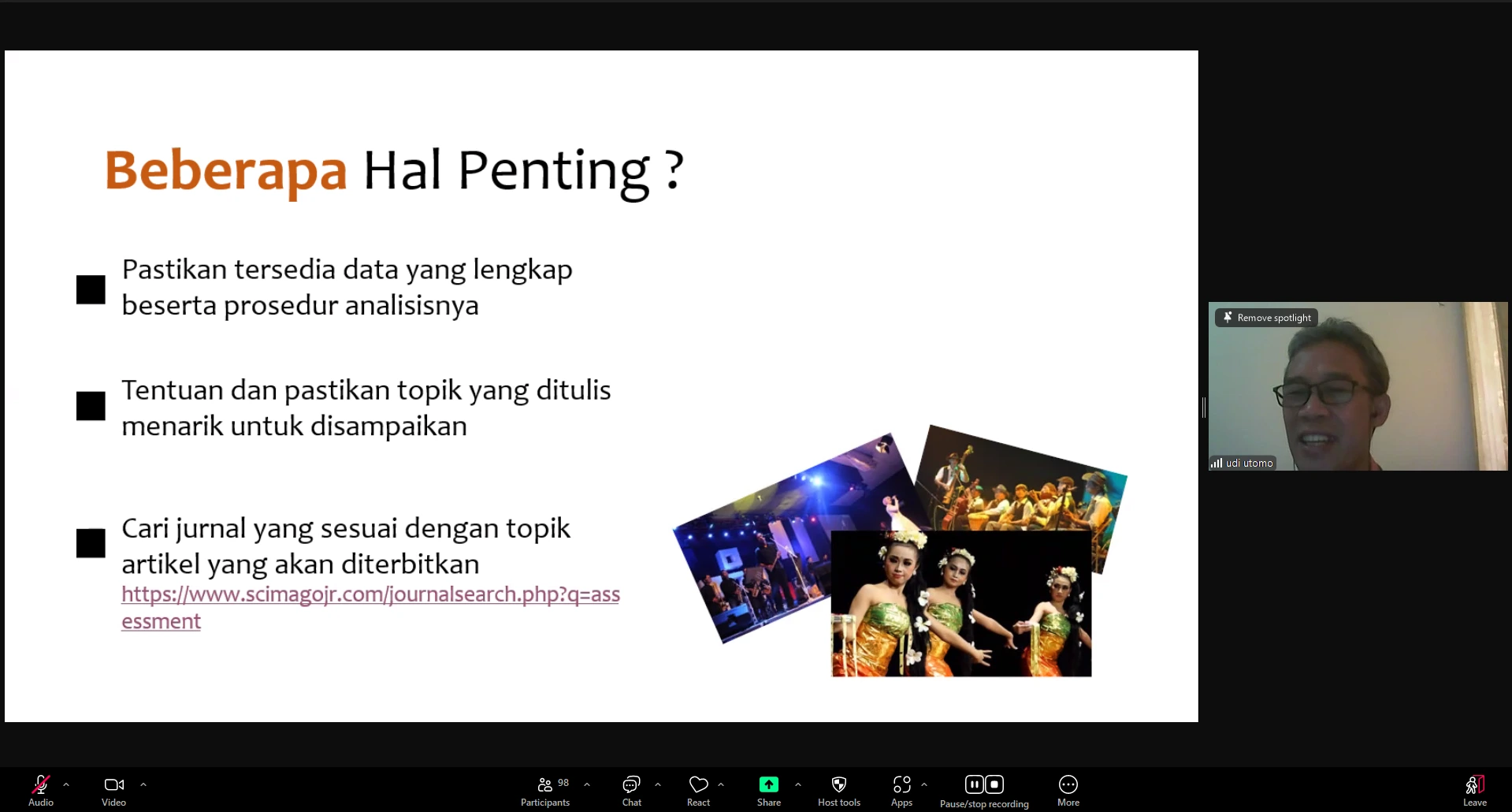
Dr. Udi Utomo, M.Sc. in his presentation said that researchers must ensure the availability of complete data along with analysis procedures. Before writing an article, first look for a journal that will publish the article. Look for a journal that discusses what will be researched first, then compile the article. For those who are just starting to write articles for Reputable International Journals, look for journals with a low H-index first. Reputable journals can be seen on the scimago website.
Compile a draft of the article based on research findings from the initial references available according to the guidelines. Because usually each journal has different guidelines, for example there are journals that have a word limit on the abstract of 150 words, some are 250 words, and there are many other examples. Dr. Udi gave an example of an article that was rejected by the journal's editorial board. In the administrative process, it is usually recommended to revise if the author's name contains capital and small letters, and so on related to the article writing guidelines. After completion in the administration section, it enters the Peer Review section. The peer review process can take up to 2 months. Articles can be rejected if the peer reviewer considers the abstract, method, hypothesis, table/figure, discussion and others to be unsound/fundamentally flawed.
It often happens that articles do not match the scope, the writing of components, systematics, writing and references do not match the guidelines. The introduction must clearly describe the background and justification of the article by previous research. The research method contains a clear description with the reasons for choosing the research design. The results and discussion already contain what, why, what else, and recommendations. The conclusion briefly and clearly contains the answer or purpose of the problem, logical conclusions based on the facts obtained, and can also include the implications of the research for science.
Dr. Udi also presented about one of the Reputable International Journals at UNNES, namely Harmonia: Journal of Arts and Education. The journal's article documents have been in the system since 2000, the volume is published every June and December, and the number of articles per issue is currently 17 articles. Reviewers at the Harmonia journal can reject articles that have been submitted by researchers or recommend to researchers that it is better to be directed to a journal that is more in line with the topic of the researcher's article.