


The Undergraduate Study Program in Malay Literature at the Faculty of Cultural Sciences (FIB), Universitas Sumatera Utara (USU), held a guest lecture titled "Malay Civilization in a Changing World." The guest speaker for the event was Prof. Ahmad Murad Merican, a professor from the International Institute of Islamic Thought and Civilization at the International Islamic University Malaysia (ISTAC-IIUM). Through this cross-sector collaboration, the event aligned with SDG 17: Partnerships for the Goals. The guest lecture took place on Thursday, August 27, 2026.
Attendees included the Chair of the USU Senate, Prof. Dr. Drs. Budi Agustono, M.S.; the Vice Dean for Research, Community Service, Cooperation, and Internationalization at FIB USU, Andi Pratama Lubis, S.S., M.Hum.; the Head of the Undergraduate Malay Literature Study Program, Arie Azhari Nasution, S.S., M.A.; as well as lecturers and students from the program. The session was moderated by Dedy Rahmad Sitinjak, S.S., M.Si.
The event began with opening remarks from Arie Azhari Nasution, S.S., M.A., Head of the Undergraduate Malay Literature Study Program at FIB USU. He noted that the lecture's theme was not merely a nostalgic reflection on past glories. "This theme serves as a call for an intellectual framework for all of us in this era of disruption. For centuries, Malay civilization has never stood as a closed entity; it is an open maritime civilization that has engaged with various waves of global culture while retaining its cosmological roots and noble values," Arie stated.
The guest lecture was officially opened by the Vice Dean for Research, Community Service, Cooperation, and Internationalization at FIB USU, Andi Pratama Lubis, S.S., M.Hum., representing the Dean of FIB USU. He remarked that in the current era of modernization, digitalization, and shifting global geopolitics, Malay civilization faces both new challenges and new opportunities. This raises the question: How can Malay civilization preserve its foundational values and identity amidst the currents of global change? How can Malay thought and wisdom contribute to addressing modern humanitarian challenges?
“These major questions will be examined through the profound insights of Prof. Merican. Let us use this opportunity to broaden our intellectual horizons, engage in critical discussion, and strengthen cross-border academic networks,” said Andi.
Addressing SDG 4: Quality Education, Prof. Ahmad Murad Merican re-examined the conceptual framework of Malay Civilization. He thoroughly explored the historical dynamics and future of the civilization, rejecting narrow views that categorize it merely as a static ethnic or linguistic entity. Instead, he asserted that it is an open and dynamic maritime civilization system.
Prof. Ahmad emphasized the need to break free from Eurocentric and Orientalist frameworks, as well as the Westphalian nation-state concept—which he argued constrains Malay civilizational thought within artificial boundaries (Epistemic Decolonization). Unlike land-based continental civilizations, the primary reservoir of Malay Civilization is the ocean; its organizational systems were shaped by the geographical reality of the archipelago and strategic shipping lanes (Maritime Identity as the Core).
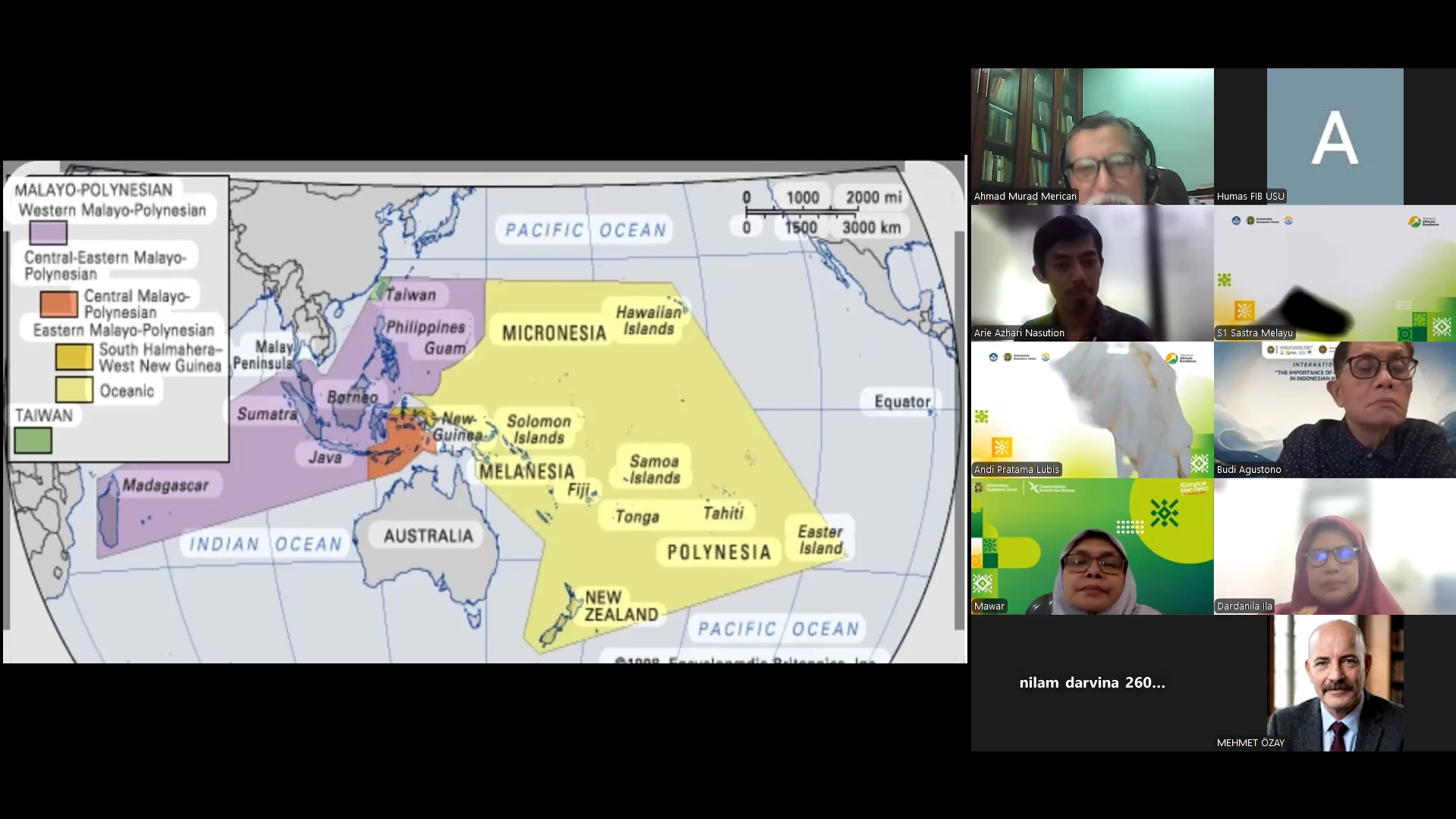
Malay Civilization was analyzed through the lenses of complex adaptive systems theory and *longue durée* (long-term historical duration), revealing non-linear patterns that span a vast geography—from Madagascar to the Pacific Islands (Complex Systems Approach). The concluding discussion also highlighted contemporary issues, including the role of artificial intelligence (AI) as a tool to be mastered, the plurality of genetic and linguistic origins, and the integration of historical layers ranging from Hindu-Buddhist influences to Islam. The guest lecture concluded that the resilience of Malay civilization lies in its open and adaptive nature regarding various global influences—ranging from Persia and India to Europe—without losing its core identity.