


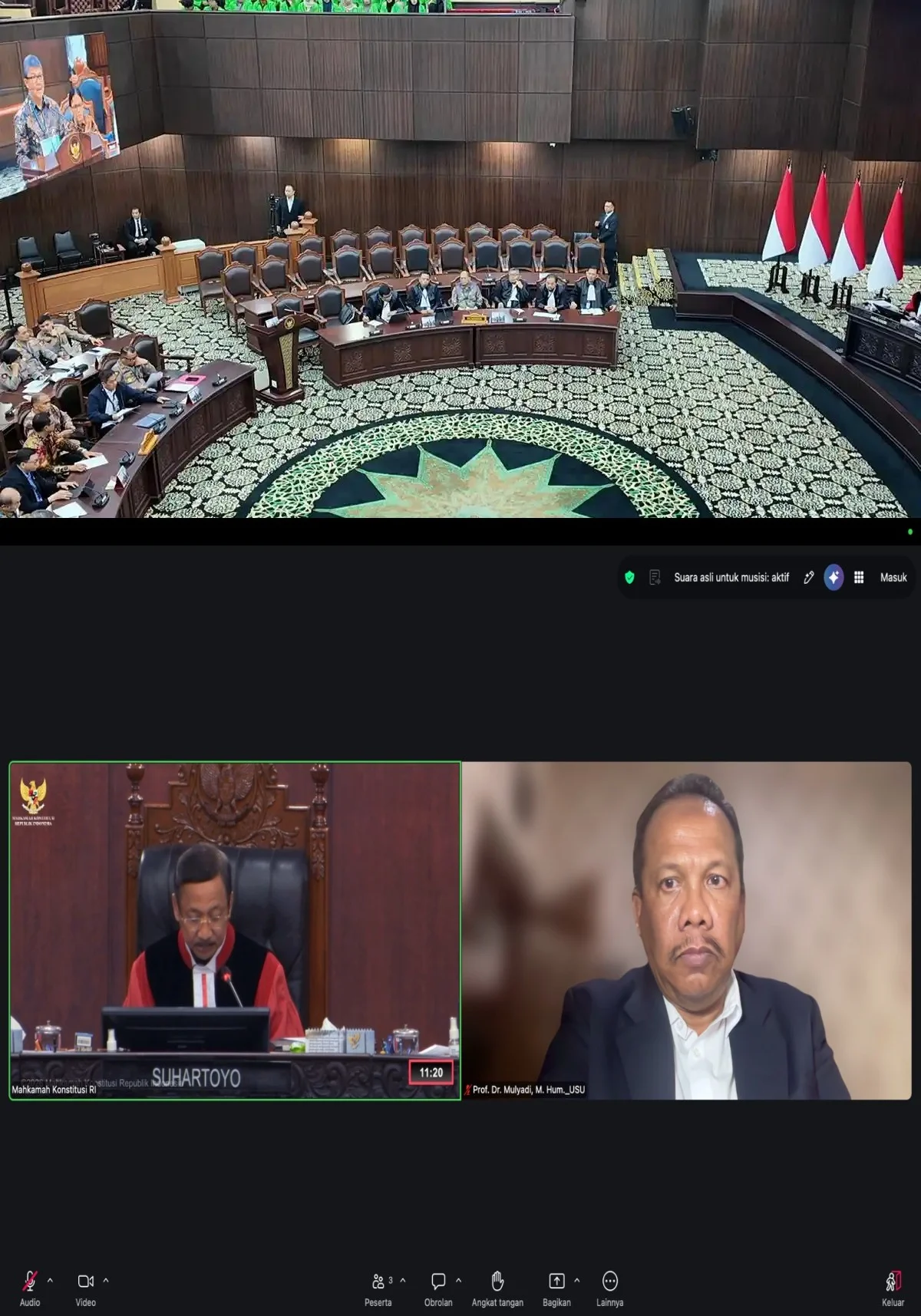
FIB USU PR - On Wednesday, 14 October 2026, Professor Mulyadi of the Faculty of Cultural Sciences (FIB), Universitas Sumatera Utara (USU), contributed his linguistic expertise to constitutional review proceedings before the Constitutional Court of Indonesia. During the hearing, he presented a linguistic analysis of the phrase “one independent and autonomous Supreme Audit Board,” as stipulated in Article 23E paragraph (1) of the 1945 Constitution of the Republic of Indonesia.
The testimony was delivered in a case concerning the judicial review of Law No. 1 of 2023 on the Criminal Code against the 1945 Constitution of the Republic of Indonesia, registered under Case No. 206/PUU-XXIV/2026.
In his presentation, Professor Mulyadi explained that analysing constitutional texts requires attention to syntactic structure, semantic meaning, and orthographic conventions. According to his linguistic analysis, the word “one” in the phrase carries a specific numerical meaning, while the phrase “independent and autonomous” functions as a complement describing the Supreme Audit Board (Badan Pemeriksa Keuangan or BPK).
From a syntactic perspective, Professor Mulyadi explained that the phrase “one independent and autonomous Supreme Audit Board” forms a unified linguistic structure. Semantically, the word “one” has a denotative meaning referring to the number one. His analysis also drew on Natural Semantic Metalanguage (NSM) theory, which examines fundamental meanings expressed through words across different languages.
Professor Mulyadi also emphasised the importance of orthography, particularly the accurate written representation of official state institutions' names. He explained that the Supreme Audit Board is the official name of a specific institution and must be linguistically distinguished from the names of other institutions. This analysis was used to clarify the meaning of the constitutional phrase concerning the status of the BPK as an independent and autonomous institution.
This linguistic expert testimony illustrates how language studies can be applied to legal and constitutional analysis. By examining sentence structures, word meanings, and the written forms of official terms, linguistic analysis can help clarify how written legal provisions are understood based on their linguistic characteristics.
Professor Mulyadi’s participation in the proceedings demonstrates the academic contribution of FIB USU scholars to national legal forums. The involvement of experts from different disciplines is important in broadening academic perspectives on legal issues that require multidisciplinary analysis.
Through this contribution, FIB USU continues to promote the development of the humanities and their relevance to societal needs, particularly in language studies, the interpretation of legal texts, and the advancement of constitutional literacy.