


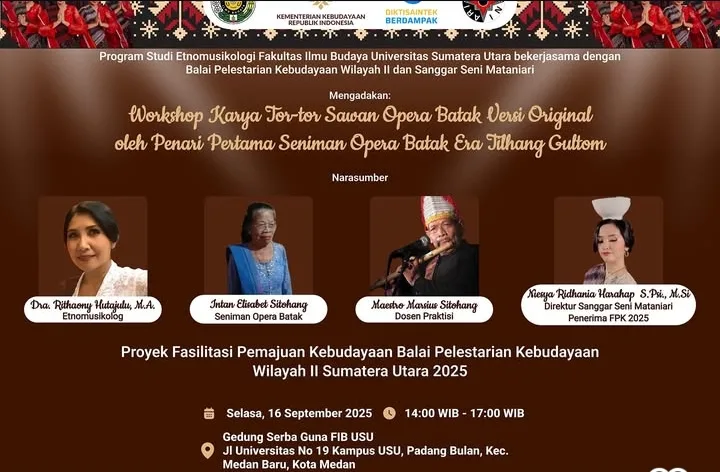


FIB USU PR - On Tuesday, September 16, 2025, the Ethnomusicology Study Program, Faculty of Cultural Sciences, University of North Sumatra (FIB USU), in collaboration with the North Sumatra Region II Cultural Preservation Center and the Mataniari Art Studio, held a Workshop on "Original Versions of the Tor-tor Sawan Batak Opera Works by the First Dancer, Batak Opera Artist Era Tilhang Gultom." The workshop featured keynote speakers Intan Elisabet Sitohang, an 80-year-old former Batak Opera dancer/artist, and Rahmatika Sholikhah, S.Sn., M.A., as moderator. Also in attendance were Prof. Dr. Dardanila, M.Hum., representing the Dean of FIB, lecturers from the Ethnomusicology study program, such as Hubari Gulo, SSn., MSn., Drs. Yoe Anto Ginting, MA., Drs. Torang Naiborhu, Mhum., and students of the Ethnomusicology study program.
Another keynote speaker was the maestro of Toba Batak traditional music, Marsius Sitohang, who is also a Batak Opera artist who has been performing since his final year. In the 1980s, she became a lecturer and practitioner of Batak Toba music in the Ethnomusicology study program at the Faculty of Cultural Sciences, University of Indonesia (USU). Intan Elisabet Sitohang is the older sister of Batak music maestro Marsius Sitohang. They are the children of Mangumbang Sitohang, a member of the first Batak opera group led by Tilhang Gultom, who served as music coordinator during Tilhang Gultom's tenure.
In the context of Batak Toba tradition, the Sawan tortor was formerly a ritual dance. However, Intan Sitohang expressed her emotion at the invitation to give this workshop and expressed her pride in the initiative and the Ethnomusicology study program's interest in presenting it at the campus forum. Using Batak language, Intan Sitohang recounted the ups and downs of her experience in Batak opera, and how the general public sometimes negatively evaluated Batak opera performers in her time. Meanwhile, Maestro Marsius Sitohang expressed his gratitude for being recruited by the Ethnomusicology study program at USU and for performing at various international events. "I can't remember all the cities I've been to," she said. "I've only been to Africa; I've been to every continent," he said.
Since 1987, Marsius Sitohang has been performing traditional Batak Toba music with the USU Arts Institute group at various national and international events. Currently, in addition to being a practicing lecturer at USU, Marsius is also a member of the Mataniari Arts Studio, founded by Rithaony Hutajulu, and has performed at international events such as Pasar Hamburg in Germany and Europhalia in the Netherlands, Belgium, and Spain.
Dra. Rithaony Hutajulu, MA, Head of the Ethnomusicology Study Program at the Faculty of Cultural Sciences (FIB) at USU, is also a Batak opera researcher who has conducted extensive research and documentation on Batak opera music and dance repertoire.
"Batak Opera is a traveling theater performance art form that emerged in the 1920s. It was a local counterpart to popular Indonesian theater forms at the time, such as Bangsawan Theater from Malaysia and Komedie Stambul from Java, which greatly influenced the emergence of theater forms from various regions in Indonesia, including East Sumatra and Tapanuli." he explained.
This workshop was the brainchild of Niesya Ridhania Harahap S.Psi, M.Si, an artist, influencer, and social psychologist who received assistance from the 2025 Cultural Advancement Facilitation Program from the North Sumatra Cultural Preservation Center. She believes that many dancers performing the Tor Tor Sawan dance still lack knowledge of the origins of the Tor Tor Sawan dance and its original choreography.
The purpose and benefit of this workshop, as conveyed by Niesya Harahap, a beneficiary of the 2025 FPK program and Director of Mataniari, is "to recognize and understand the essence and structure of the dance movements underlying Tor Tor Sawan, so that future creations and creativity based on Tor Tor Sawan remain rooted in its original concept, artistry, aesthetics, and ethics."
Furthermore, Niesya also provided motivation and a psychological explanation for why young people are increasingly abandoning tradition. "In terms of identity and self-development, adolescence and early adulthood are vulnerable times, characterized by the search for identity. And the references they follow are generally from peer groups who emphasize modern, digital, and global living, so traditions are often seen as irrelevant and outdated. So, we must recognize that tradition doesn't mean returning to the past. Rather, by recognizing our cultural roots, our identity strengthens in this ever-changing world," Niesya explained.
What was very interesting about this workshop was the presentation of two versions of tor tor sawan from different eras. One choreography of Tortor Sawan was performed by the Cilpa Nusantara group consisting of students and alumni of the Ethnomusicology study program with a version choreographed by Rithaony Hutajulu. As the culmination of the activity, in the midst of her unhealthy condition and advanced age, Intan Elisabet Sitohang was willing to perform the original version of tortor sawan taught by her mother br Simbolon who was the first dancer of tortor Sawan in the Tilhang Gultom era. All workshop participants were very impressed with the beauty of the tortor sawan movements of the elderly Batak opera artist. Intan Elisabet Sitohang was still able to dance the tortor sawan with enthusiasm which had quite heavy movements and required sufficient balance.