Seminar Nasional Kolaborasi UNAND 2025.webp)
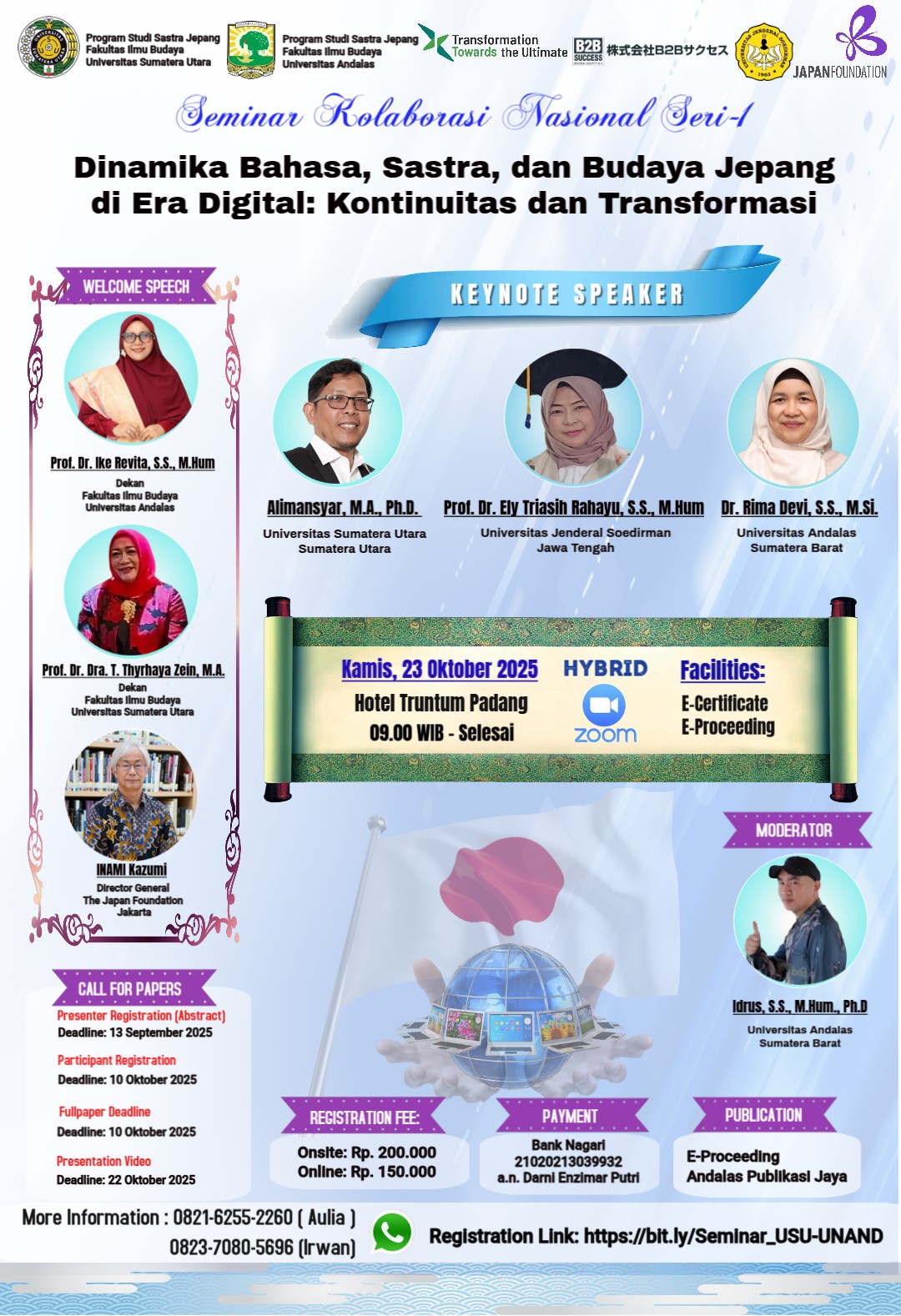
The Undergraduate Program in Japanese Literature of the Faculty of Cultural Sciences, Universitas Sumatera Utara (FIB USU) collaborated with the Undergraduate Program in Japanese Literature of the Faculty of Cultural Sciences, Universitas Andalas (FIB UNAND) in organizing the National Collaborative Seminar 2025 with the theme “Dynamics of Japanese Language, Literature, and Culture in the Digital Era: Continuity and Transformation”. The activity was held in hybrid format on Thursday, October 23, 2025, at Hotel Truntum Padang and via the Zoom platform. The event poster listed this activity as the National Collaborative Seminar Series-1.
The seminar addressed the development of Japanese language, literature, and culture in the context of the digital era. Technological developments and changes in the social environment have created new dynamics in Japanese studies, while also opening opportunities to examine the continuity and transformation of various aspects of Japanese language, literature, and culture. Through this activity, participants had the opportunity to attend academic presentations and exchange insights on developments in Japanese studies.
The seminar featured three keynote speakers, namely Alimansyar, M.A., Ph.D. from Universitas Sumatera Utara, Prof. Dr. Ely Triasih Rahayu, S.S., M.Hum. from Universitas Jenderal Soedirman, and Dr. Rina Devi, S.S., M.Si. from Universitas Andalas. The keynote sessions were moderated by Idrus, S.S., M.Hum., Ph.D. from Universitas Andalas.
The series of activities began with participant registration, the opening ceremony, the singing of the Indonesian national anthem, and a prayer. This was followed by remarks from the Head of the Undergraduate Program in Japanese Literature of FIB USU, Alimansyar, Ph.D., the Director General of The Japan Foundation Jakarta, Mr. INAMI Kazumi, and the Dean of the Faculty of Cultural Sciences, Universitas Sumatera Utara, Prof. Dr. T. Thyrhaya Zein, M.A. The Dean of the Faculty of Cultural Sciences, Universitas Andalas, Prof. Dr. Ike Revita, S.S., M.Hum., also delivered remarks and officially opened the activity.
The organization of the seminar demonstrated synergy between the Undergraduate Program in Japanese Literature of FIB USU and the Undergraduate Program in Japanese Literature of FIB UNAND. Students of the Undergraduate Program in Japanese Literature of FIB UNAND were also involved in the organizing committee and assisted with the implementation of the activity. Their involvement provided experience in supporting the organization of academic activities while also becoming part of the learning process outside the classroom.
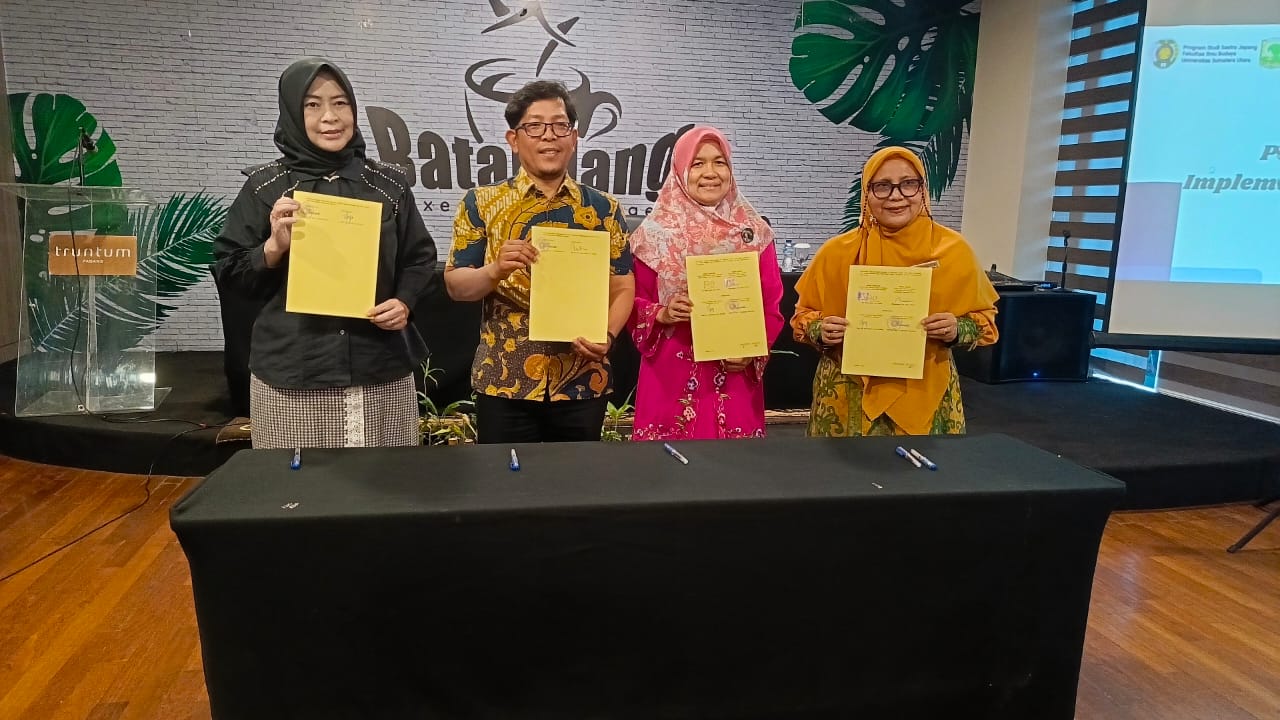
In addition to the seminar, the series of activities also served as a momentum to strengthen institutional cooperation through the signing of an Implementation Agreement (IA) involving Universitas Sumatera Utara, Universitas Andalas, and Universitas Jenderal Soedirman. The cooperation concerned the implementation of the Three Pillars of Higher Education, which include the provision of education, research, and community service, joint research, scientific publications, the organization of scientific seminars or conferences, and student exchanges.
The hybrid format allowed participants to attend the activity directly at Hotel Truntum Padang or online via Zoom. This format provided opportunities for participants from various regions to attend the seminar and interact in an academic forum without being limited by location.
The National Collaborative Seminar 2025 was one form of strengthening academic cooperation between the Undergraduate Program in Japanese Literature of FIB USU and FIB UNAND. The participation of academics from various higher education institutions, as well as the involvement of students in organizing the activity, provided opportunities for the exchange of knowledge and experiences in the fields of Japanese language, literature, and culture.
Through the theme “Dynamics of Japanese Language, Literature, and Culture in the Digital Era: Continuity and Transformation”, the activity not only served as an academic forum to discuss developments in Japanese studies, but also as part of strengthening institutional relations and developing cooperation between institutions. This collaboration is expected to continue to develop through various joint academic activities in the fields of education, research, community service, and the development of Japanese language, literature, and culture studies.