


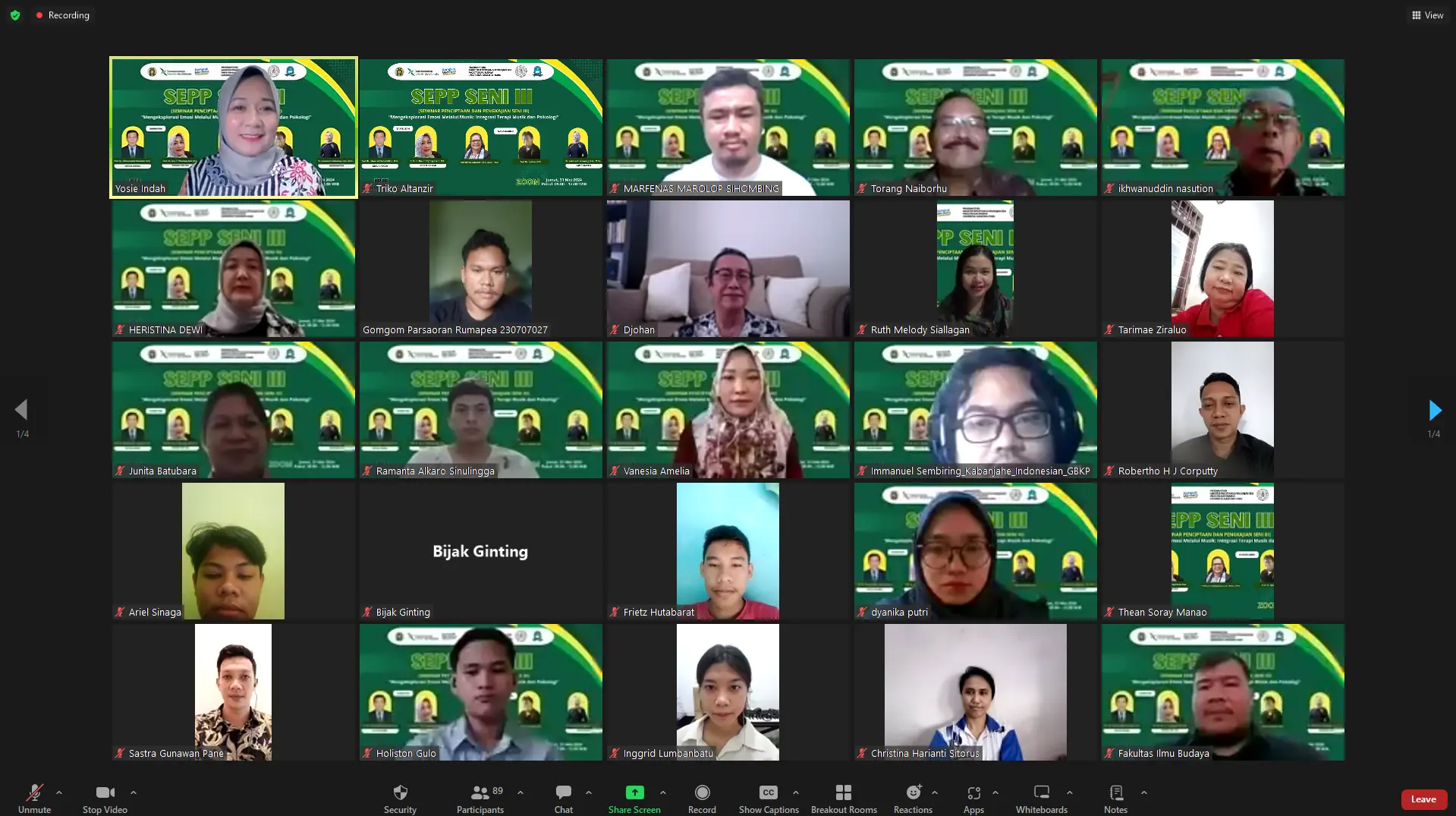
"Music has a positive effect on a person's health, mental and emotion. Music can relieve stress and anxiety. Music can help mood, strengthen the body's endurance and the immune system, increase endorphins and adrenaline. Music can increase concentration and improve long-term memory. How does the system work and the aspects behind it? Hopefully our resource person can answer it today," said Dra. Heristina.


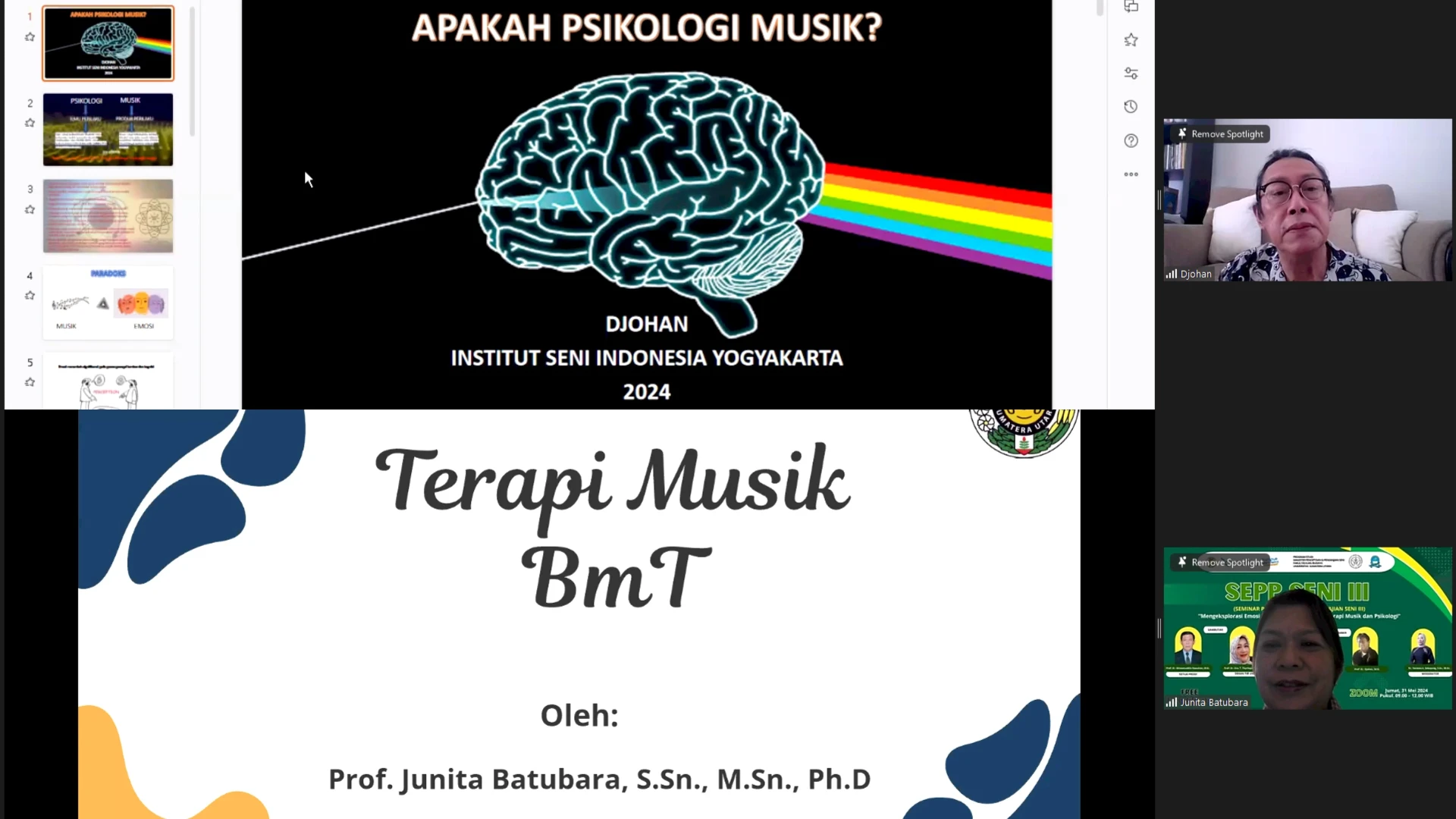
FIB USU PR - Friday, May 31st 2024, the Postgraduate of Arts Creation and Studies Study Program, Faculty of Cultural Sciences (FIB), Universitas Sumatra Utara (USU) held its Third Seminar with the theme Exploring Emotions Through Music: Integration of Music Therapy and Psychology. The seminar also invited guest speaker Prof. Dr. Djohan, M.Sc. from the Institute Seni Indonesia Yogyakarta and Prof. Junita Batubara, S.Sn., M.Sn., Ph.D. from Universitas HKBP Nommensen.
The seminar was officially opened by the Dean of FIB USU who was represented by Vice Dean II FIB USU Dra. Heristina Dewi, M.Pd. Vice Dean II in her speech conveyed the research she had read. "Music has a positive effect on a person's health, mental and emotion. Music can relieve stress and anxiety. Music can help mood, strengthen the body's endurance and the immune system, increase endorphins dan adrenaline. Music can increase concentration and improve long-term memory. How does the system work and the aspects behind it? Hopefully our resource person can answer it today," said Dra. Heristina.
The first resource person, Prof. Dr. Djohan, M.Sc. explains the Psychology of Music. Collectively, these musical experiences are varied and highly complex. Many questions arise during this discussion, such as how humans become musical creatures, how and why our bodies respond to music, why people have emotional responses to music, and so on. Music psychology seeks to understand and explain phenomena that are at the core of what it means to be human.
All societies across the planet and throughout history have engaged in musical behavior. In fact, humans throughout the world engage in musical behavior to such an extent that many consider music to be a species-specific trait. "Collectively, this musical experience is very diverse, very complex, and it is the field of music psychology that seeks to understand and explain a phenomenon that seems very important in that sense: being human," said Prof. Djohan.
The second resource person, Prof. Junita Batubara, S.Sn., M.Sn., Ph.D. explains about BmT (Box Music Therapy). Music Therapy is a therapeutic approach through the properties of music for natural emotions and helping mental health. There are several methods in music therapy, namely making musical compositions - creating - forms - expressions, writing songs - lyrics/melodies - expressing feelings, singing (expressing emotions and can relieve stress), dancing (body movements - related to music), and listening to music. (affects mood, reduces anxiety).
There are several BmT tools used by Prof. Junita, namely GSR (Galvanic Skin Response), Headphones, MPX5050dp which is a pressure sensor, and memory card. Prof. Junita has conducted research related to BmT on patients and health workers. "From the results of observations of patient with initial 'EF', after music therapy, patient became better at walking, were able to talk with greater focus, and BmT also created a feeling of calm so that it was able to relieve the pain that the patient had been experiencing," said Prof. Junita.