


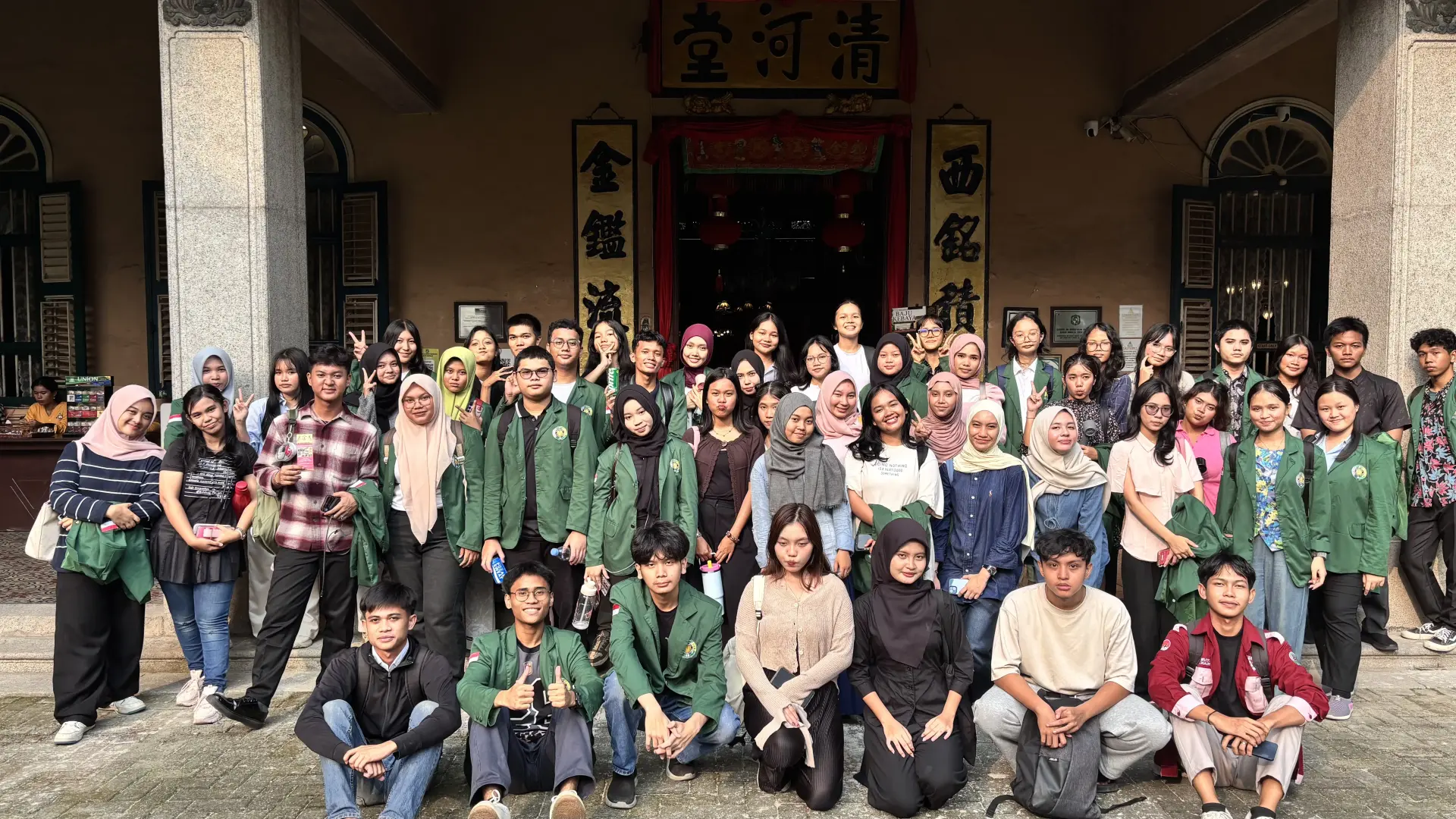
Bahasa mandarin - On Monday, September 14, 2026, first-year students of the 2026 cohort of the Mandarin Language Study Program participated in a Study Trip to Tjong A Fie Mansion in Medan. The activity was accompanied by the Mandarin Language Study Program Student Association (HUASHAN) as part of an effort to introduce students to the academic environment while broadening their understanding of the history, culture, and diversity of Medan’s society.
The Study Trip served as an opportunity for out-of-class learning, allowing students to connect the knowledge gained through their coursework with the social and cultural realities of their surrounding environment. Through their visit to Tjong A Fie Mansion, students were introduced to one of Medan’s important historical heritage sites, which reflects the development of the city’s multicultural society. The historic building provided a meaningful learning environment for exploring historical developments, interethnic interactions, and the cultural diversity that has shaped Medan.
For students of the Mandarin Language Study Program, this experience was particularly relevant, as language learning cannot be separated from an understanding of the culture and social context of its speakers. Learning about Chinese history and culture in Indonesia is an important component in developing students’ cross-cultural awareness. In this way, their Mandarin language proficiency can develop alongside a deeper understanding of the values, traditions, history, and social life associated with Chinese culture.
The involvement of HUASHAN also contributed to creating an interactive and collaborative learning environment. In addition to gaining an academic experience, the first-year students had the opportunity to develop communication, camaraderie, and connections with their peers from the beginning of their university journey. These interactions support the students’ adaptation to academic and organizational life within the Mandarin Language Study Program.
The activity also directly aligns with the Sustainable Development Goals (SDGs), particularly SDG 4: Quality Education, through contextual learning and out-of-class educational experiences that enrich students’ knowledge and skills. Furthermore, the activity supports SDG 11: Sustainable Cities and Communities by increasing students’ awareness of the importance of preserving cultural and historical heritage as an integral part of urban identity and the sustainability of communities.
The values of diversity and intercultural interaction fostered through the activity are also in line with SDG 10: Reduced Inequalities, particularly in promoting inclusivity, mutual respect, and openness toward diverse cultural backgrounds. Thus, the Study Trip was not merely a recreational activity for new students but also a meaningful learning experience that encouraged awareness of the importance of diversity, tolerance, cultural preservation, and responsibility for historical heritage.
Through this activity, the 2026 cohort of students in the Mandarin Language Study Program is expected to gain a meaningful learning experience, develop a deeper appreciation of Medan’s rich history and cultural heritage, and cultivate cross-cultural perspectives that will support their academic journey in the Mandarin Language Study Program. With the support of HUASHAN, the Study Trip serves as an important first step toward fostering students who possess not only academic and linguistic competencies but also a strong appreciation for culture and history, a sense of social responsibility, and an awareness of sustainable development.