


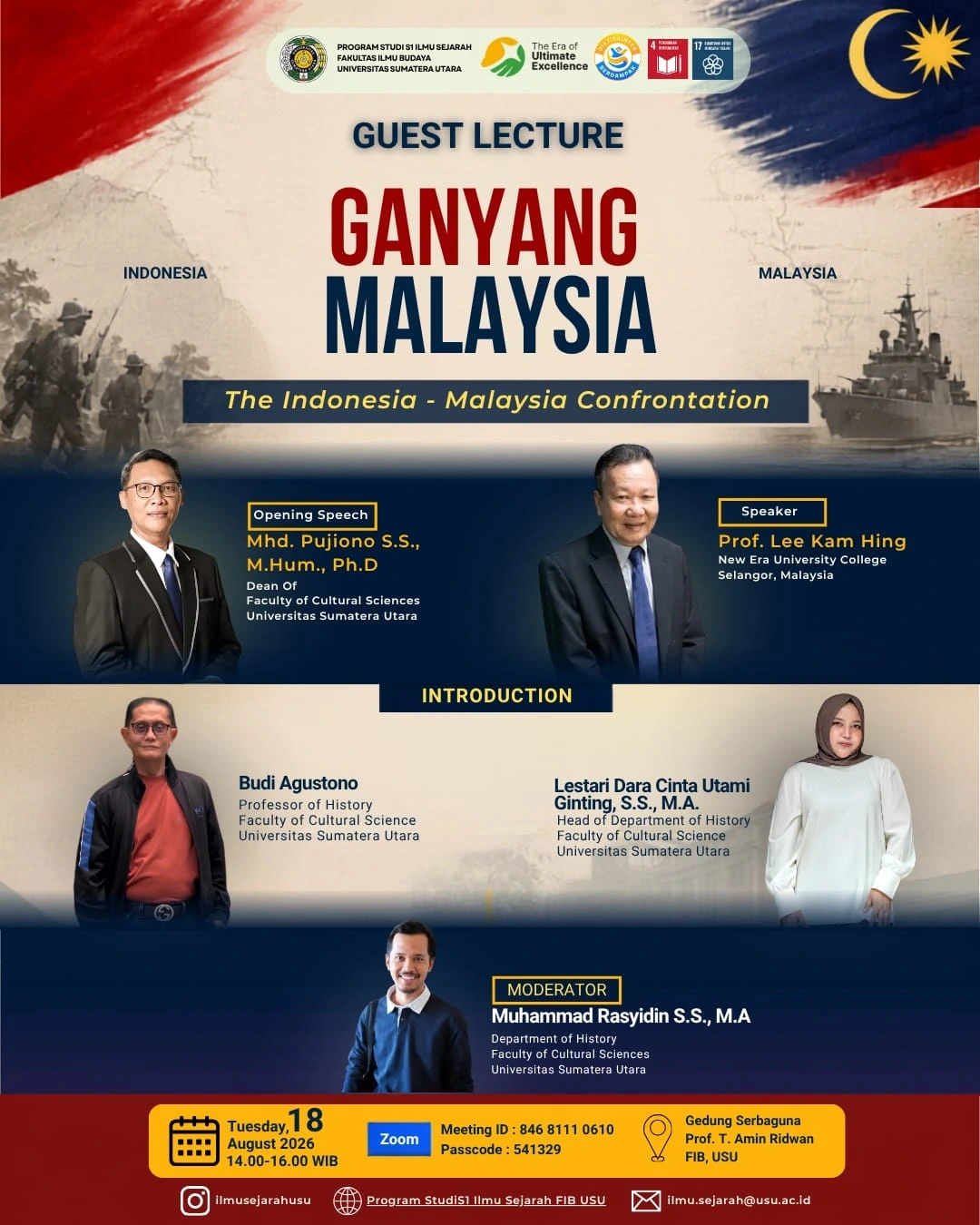
The Undergraduate History Study Program, Faculty of Cultural Sciences, Universitas Sumatera Utara, held a guest lecture entitled “Ganyang Malaysia: The Indonesia–Malaysia Confrontation” on Tuesday, 18 August 2026. The event was conducted in a hybrid format at the Prof. T. Amin Ridwan Multipurpose Hall, FCS USU, and via Zoom Meeting.
The guest lecture was also part of the welcoming program for the new students of the Undergraduate History Study Program, Class of 2026. Through this activity, students were introduced from the beginning of their studies to an approach to history that goes beyond dates and chronology, encouraging them to examine sources, consider different perspectives, and understand the broader context behind historical events.
The lecture featured Prof. Lee Kam Hing, a Malaysian historian from New Era University College, Selangor, as the guest speaker. The event was officially opened by the Dean of the Faculty of Cultural Sciences USU, Mhd. Pujiono, S.S., M.Hum., Ph.D. The welcoming remarks were delivered by Lestari Dara Cinta Utami Ginting, S.S., M.A., Head of the Undergraduate History Study Program, while Prof. Dr. Drs. Budi Agustono, M.S., Professor of History at USU, gave an introduction before the main lecture. The discussion was moderated by Muhammad Rasyidin, S.S., M.A.
In his presentation, Prof. Lee invited participants to look at the Indonesia–Malaysia Confrontation of 1963–1966 from a broader perspective. He discussed the formation of Malaysia, the Cold War context, Indonesia’s domestic political dynamics, the course of the conflict, and the diplomatic process that eventually brought the Confrontation to an end. His presentation showed that the conflict cannot be separated from ideological issues, geopolitical interests, and political developments within Indonesia.
The call to “Ganyang Malaysia” was also an important part of the discussion. Prof. Lee placed the expression within the political context of 1963, including the Brunei Revolt, the formation of the Federation of Malaysia, the Manila Summit, Maphilindo, and the growing tension between Indonesia and Malaysia.
The lecture did not stop at the period of conflict. Prof. Lee also explained the process through which relations between Indonesia and Malaysia were restored through diplomacy. Negotiations between Adam Malik and Tun Razak in Bangkok in 1966 became an important step towards the normalization of relations between the two countries. In the following year, Indonesia and Malaysia, together with other Southeast Asian countries, became founding members of ASEAN on 8 August 1967.
For the new students, the guest lecture offered an early experience of how history is studied and discussed in an academic setting. In her remarks, the Head of the Undergraduate History Study Program emphasized that studying history is not simply about memorizing dates. Students are encouraged to read historical sources, explore archives, conduct interviews, write, discuss, and critically question ideas that are often taken for granted.
The discussion became even more engaging with the participation of two students from Universiti Kebangsaan Malaysia. Their presence created a space for cross-border dialogue and allowed the Indonesia–Malaysia Confrontation to be discussed from a wider range of perspectives.
Through this activity, the Undergraduate History Study Program FCS USU aims to build an open and active academic environment from the very beginning of students’ university experience. Students are encouraged not only to learn in the classroom, but also to take part in guest lectures, seminars, research, internships, competitions, and other academic activities throughout their studies.
The guest lecture also offered an important reminder that the history of conflict does not always end in hostility. The Indonesia–Malaysia Confrontation provides an example of how conflict can eventually give way to diplomacy, reconciliation, and regional cooperation in Southeast Asia.
This activity supports SDG 4: Quality Education by strengthening students’ academic learning experiences and SDG 17: Partnerships for the Goals through knowledge exchange and the development of academic networks between Indonesia and Malaysia.