


.webp)
USU's Ethnomusicology Study Program Holds Public Lecture on "Applied Ethnomusicology in the Context of Preserving and Developing Regional Music"
Medan, August 24, 2026 — The Ethnomusicology Study Program at the Faculty of Cultural Sciences, Universitas Sumatera Utara (FIB USU), held a Public Lecture themed "Applied Ethnomusicology in the Context of Preserving and Developing Regional Music." The event featured Denis Setiaji, S.Sn., M.Sn., Coordinator of the Ethnomusicology Study Program at the Indonesian Institute of the Arts (ISI) Surakarta, as the guest speaker. Around 40 participants attended, comprising students and lecturers from the Ethnomusicology Study Program at FIB USU.
The lecture served as an academic space for the campus community to deepen their understanding of developments in ethnomusicology, particularly from the perspective of applied ethnomusicology and its contribution to the preservation and development of regional music. The event was also part of the study program's effort to strengthen students' learning outcomes through direct interaction with academics and practitioners from other institutions.
The event opened with remarks from the Ethnomusicology Study Program at FIB USU, noting that the public lecture aligned with the program's learning objectives. Through this activity, students were expected to gain not only theoretical knowledge from coursework but also a broader perspective on how ethnomusicology can be applied across various aspects of community life. Strengthening students' competencies and insights through such academic activities also aligns with the Sustainable Development Goals (SDGs), particularly SDG 4: Quality Education, by developing students' knowledge and capacity to make a broader contribution to society.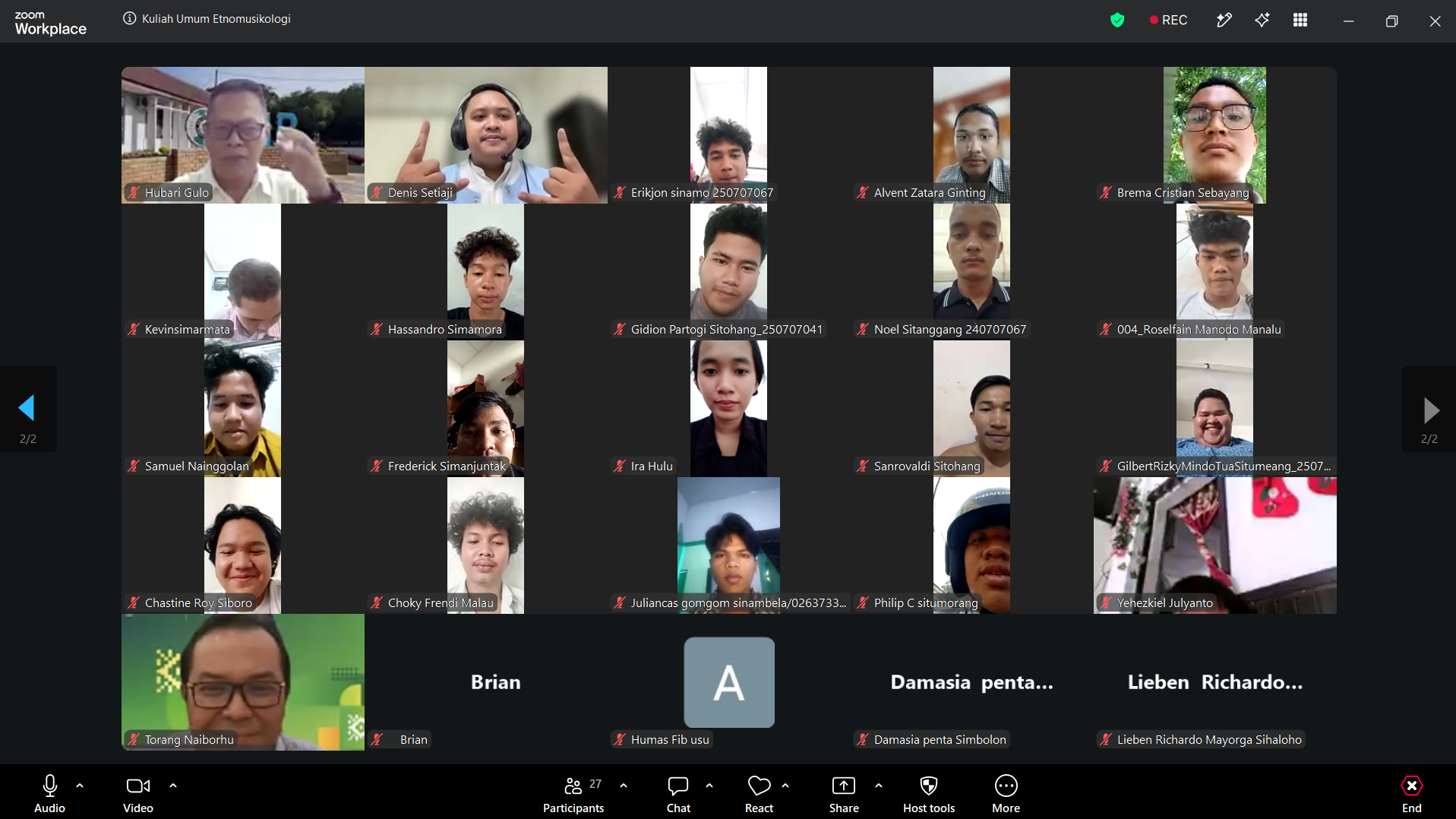
The event continued with remarks from the Dean of FIB USU, represented by the Vice Dean for Academic Affairs, Student Affairs, and Alumni, Dr. Zulfan, S.S., M.Hum. In his remarks, he stated that Universitas Sumatera Utara hopes to produce graduates who possess not only academic competence but also the ability to make a real impact and contribution to society. This spirit aligns with the purpose of the public lecture, which encourages students to see how the knowledge they gain can be applied and benefit the wider community.
The session was then moderated by Rahmatika Luthfiana Sholikhah, S.Sn., M.A., a lecturer and Secretary of the Ethnomusicology Study Program at FIB USU. During the presentation, Denis Setiaji, S.Sn., M.Sn. discussed the concept of applied ethnomusicology in relation to the preservation and development of regional music.
In his presentation, Denis Setiaji emphasized that applied ethnomusicology is not an opposition to pure ethnomusicology, but rather part of the broader development of the discipline. According to him, the results of ethnomusicological research should not stop merely at the production of academic knowledge, but can be developed into concrete works and actions that benefit society.
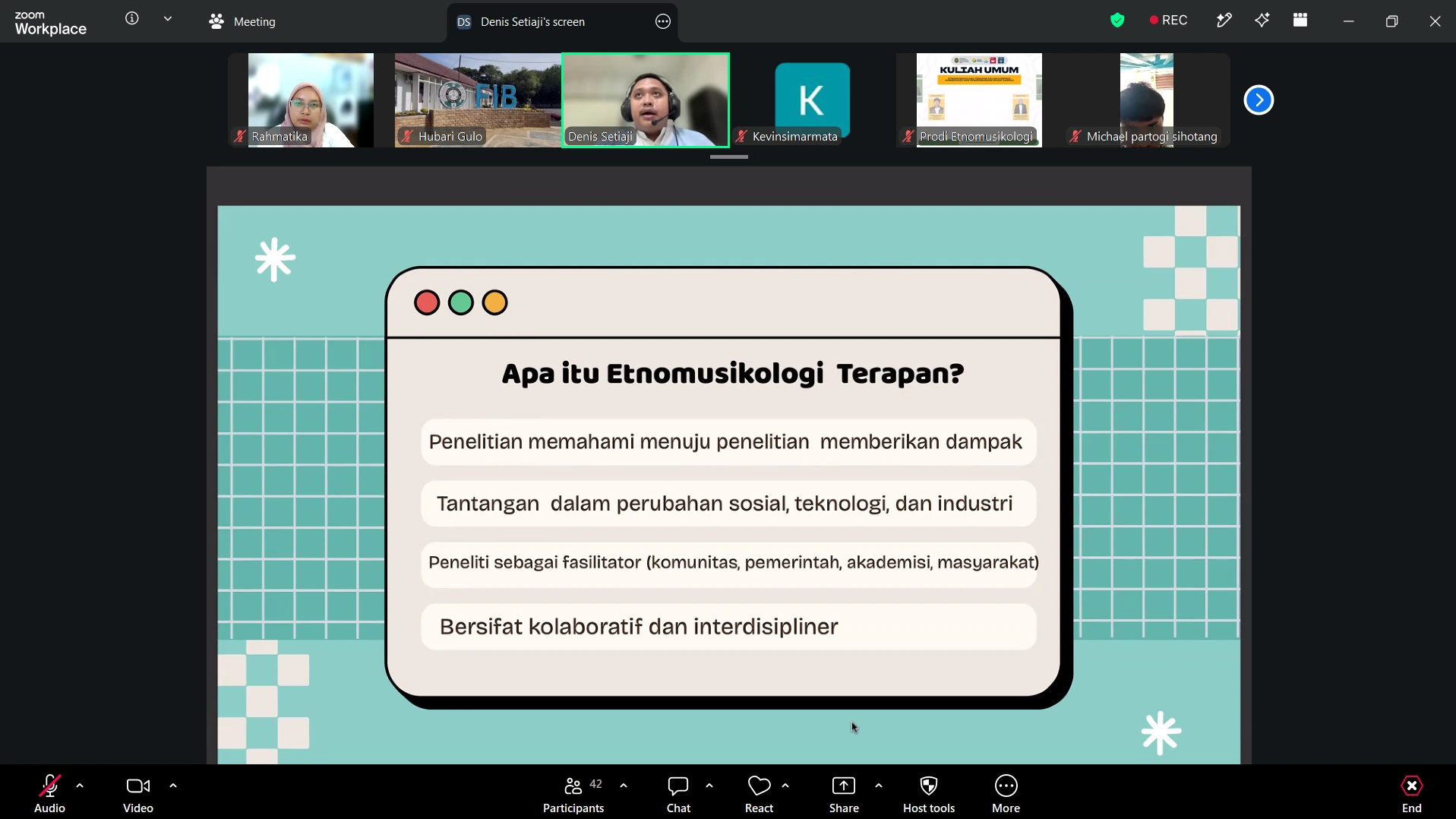
He further explained that research findings can serve as a foundation for designing various activities and works relevant to community needs. In this way, ethnomusicological research has the potential to generate a wider impact, especially when the knowledge gained through research is translated into actions or programs that communities can genuinely benefit from.
Denis also explained that ethnomusicology has the opportunity to work alongside and collaborate with various other disciplines. Ethnomusicology is not only connected to art and culture, but can also intersect with other fields, ranging from medicine, education, and community empowerment, to advocacy. This cross-disciplinary collaboration demonstrates that ethnomusicology has broad room to contribute to addressing various social and cultural issues.
This approach also highlights the relevance of ethnomusicology to the sustainable development agenda. Efforts to understand, document, preserve, and develop regional music can become part of strengthening the sustainability of cultural heritage and community identity, which relates to SDG 11: Sustainable Cities and Communities. Meanwhile, the opportunities for cross-disciplinary and cross-institutional collaboration discussed in the lecture reflect the spirit of SDG 17: Partnerships for the Goals, through the development of cooperative efforts to produce knowledge and contributions that benefit society.
The presentation gave students a broader perspective on the extensive scope of work and contribution within ethnomusicology. Music was positioned not merely as an object of study, but also as part of community life — a medium that can support efforts in cultural conservation, cultural development, empowerment, and the resolution of social issues.
The event continued with a discussion and question-and-answer session involving students and lecturers. This session became a space for further dialogue on the position of applied ethnomusicology, the challenges of preserving regional music, and opportunities for the discipline's development within the context of contemporary society.
Through this public lecture, the Ethnomusicology Study Program at FIB USU continues its efforts to strengthen students' academic insight while fostering the understanding that ethnomusicology is a field of study with great potential to make real contributions to the conservation, development, and sustainability of regional music and culture. The event also reflects a broader commitment to impactful education, raising awareness of cultural heritage sustainability, and opening space for collaboration that supports the contribution of knowledge to society.