Description
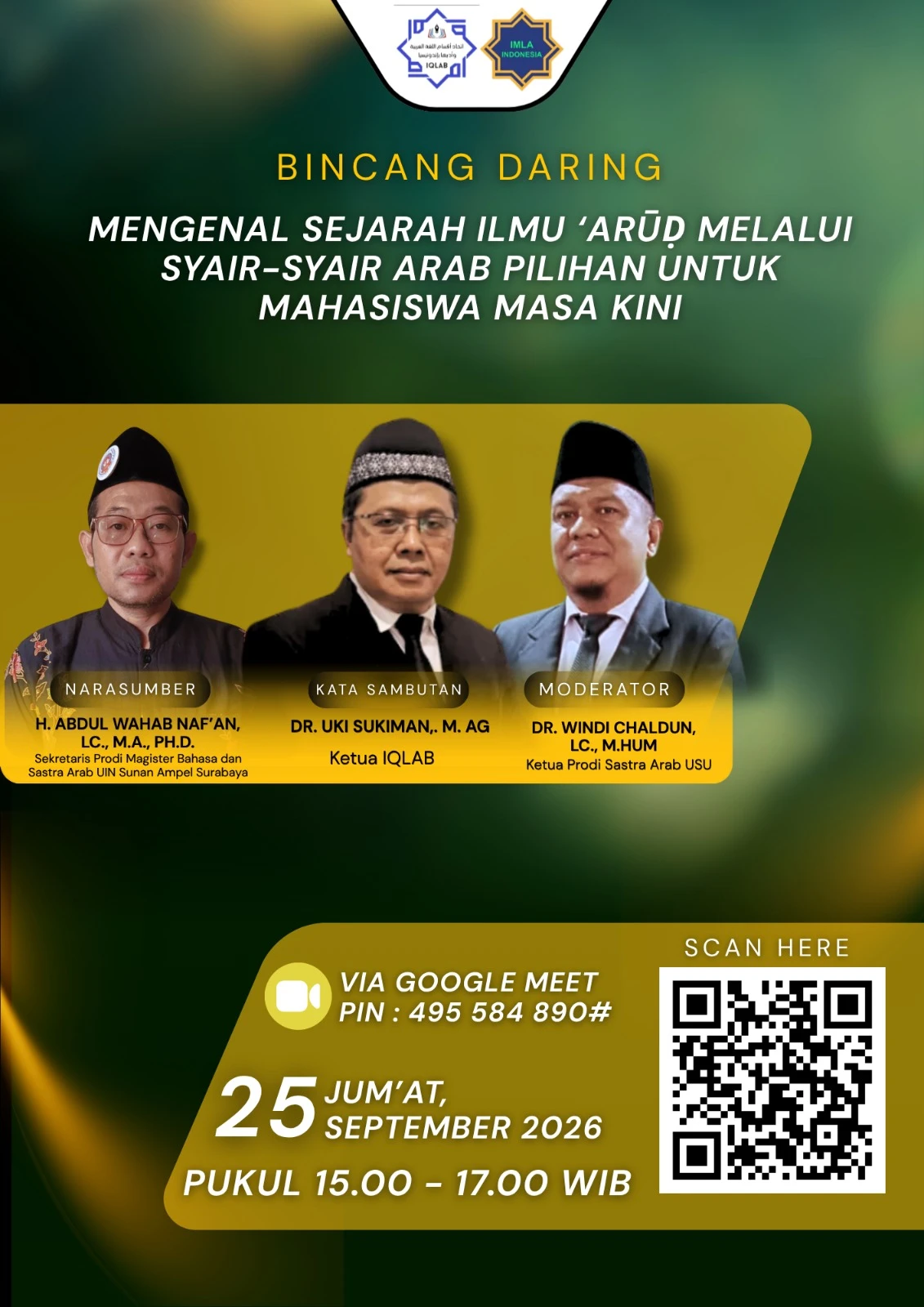
The IQLAB (Ittihad Aqsam Al-Lughah Al-Arabiyah wa Adabiha) Indonesia Online Discussion was held once again as an academic forum for lecturers, researchers, and students of Arabic language and literature across Indonesia. On Friday, September 25, 2026, this online event—organized in collaboration with various Arabic Language and Literature Departments throughout Indonesia—was successfully conducted virtually via Google Meet (PIN: 495 584 890#) from 15:00 to 17:00 WIB, carrying the theme, “Understanding the History of the Science of ‘Arūḍ through Selected Arabic Poetry for Contemporary Students.” This academic gathering aimed to strengthen historical understanding of the discipline while cultivating aesthetic sensitivity in reading both classical and modern Arabic literary heritage. Furthermore, this initiative serves as a tangible manifestation of the academic commitment of the Faculty of Cultural Sciences, Universitas Sumatera Utara (FIB USU) to supporting the Sustainable Development Goals (SDGs), particularly SDG 4 (Quality Education) through the provision of an inclusive and transformative humanities learning platform, and SDG 17 (Partnerships for the Goals) by bolstering inter-university academic networks.
The event was hosted and moderated by Dr. Windi Chaldun, Lc., M.Hum., Head of the Arabic Literature Study Program at Universitas Sumatera Utara (FIB USU). The opening session commenced with a keynote address by the Chairman of IQLAB Indonesia, Dr. Uki Sukiman, M.Ag. In his remarks, Dr. Uki Sukiman emphasized the importance of consistently hosting scientific forums such as this online discussion to reinforce the scholarly foundation of Arabic language and literature in Indonesia, while fostering closer synergies among academic institutions, particularly Arabic Department programs. This strategic collaboration among the Arabic Literature Study Program of FIB USU, IQLAB Indonesia, and partner higher education institutions reflects the implementation of SDG 17 (Partnerships for the Goals) in building a solidary, open, and sustainable educational ecosystem.
The keynote session featured a single speaker, H. Abdul Wahab Naf'an, Lc., M.A., Ph.D., Secretary of the Master’s Program in Arabic Language and Literature at the Faculty of Adab and Humanities, UIN Sunan Ampel Surabaya. In his presentation, he invited participants to undergo a paradigmatic reorientation toward the science of ‘Arūḍ. For many students, ‘Arūḍ is often narrowly perceived as a complex list of Taf‘īlah, Zi‘āf, ‘Illah, and names of Baḥr that must be memorized solely for examination purposes. The speaker dismantled this view by asserting that ‘Arūḍ is not merely a burden of memorization, but a scientific method for observing and analyzing the rhythmic regularity of sound that lived and was practiced in Arabic poetry long before al-Khalil ibn Ahmad theoretically formulated it. This pedagogical reorientation—shifting from mechanical memorization to critical conceptual understanding—aligns with the achievement of SDG 4 (Quality Education) actively promoted by FIB USU to cultivate more adaptive, meaningful, and relevant language and literature teaching methodologies for contemporary students.
The History of Codification and the Thought of al-Khalil ibn Ahmad
From a historical perspective, the oral tradition of pre-Islamic Arab society had naturally produced metered (wazn) poetry through listening, memorization, recitation, and practice, long before the term ‘Arūḍ existed. The speaker delineated three conceptual levels: al-shi‘r as literary practice, al-wazn as metrical regularity, and al-’Arūḍ as a system of analysis and classification. This was analogized to the science of Nahw (grammar), wherein Arab society spoke grammatically well before Sībawayh compiled al-Kitāb. The phrase al-waznu qabla al-Khalīl, wa al-’Arūḍu ‘inda al-Khalīl underscores that al-Khalil ibn Ahmad al-Farāhīdī (d. 175 AH/791 CE) did not invent wazn, but rather observed, abstracted, and named the existing rhythmic patterns.
Al-Khalil’s intellectual mastery in Basra lay in his ability to discern a system behind what was heard (Ra'ā fī al-Masmū‘i Niẓāman). Although narrative traditions often attribute the discovery of this discipline to a prayer in Mecca or the rhythmic strokes of a blacksmith, the speaker stressed the vital distinction between intuitive inspiration and rigorous scientific work. Al-Khalil’s scholarly achievement was built upon the method of istikrā’ (textual induction from poetic data), abstraction, the formation of rhythmic units, and culminated in the formulation of Dawā’ir al-’Arūḍ (Prosodic Circles). The five circles (al-Mukhtalif, al-Mu‘talif, al-Mujtalab, al-Mushtabih, and al-Muttafiq) demonstrate rotational relationships between different baḥr (meters), transforming the understanding of prosody from a random list into a cohesive structural system.
Scientific Development and Comparative Modern Prosody
The evolution of the science of ‘Arūḍ did not end with al-Khalil. Subsequent generations, such as al-Akhfash who introduced baḥr al-Mutadārik, continued to enrich and refine the system. Analytical mechanisms such as zi‘āf (metrical deviations) and ‘illah (metrical variations) were formulated to address deviations from the ideal forms of baḥr in actual poetic composition. However, in classroom instruction, a primary challenge persists: students tend to passively accept mechanical formulas without grasping the fundamental intellectual inquiries that birthed them.
In comparing classical ‘Arūḍ with modern prosodic studies, the speaker cautioned scholars and students against simplistic terminological translation. Khalilian terms such as Sabab, Watad, Taf‘īlah, and Baḥr operate within their own systematic framework and cannot be directly equated with Western prosodic terms like Syllable, Foot, or Meter. Citing modern research by scholars such as Wolfhart Heinrichs and Oriana Capezio, the speaker emphasized that the Arabic metrical tradition constitutes a highly intricate theoretical construct. Consequently, terminology should not be translated without first understanding the conceptual system underpinning it.
Appreciation of Selected Poetry and Educational Values for Students
To ground metrical theory in practice, the speaker presented an analysis of selected Arabic poems rich in educational and moral lessons for contemporary students. Beginning with lines from the Mu‘allaqah of Imru’ al-Qays (Qifā nabki...) set in baḥr al-Ṭawīl, the speaker conveyed a poetic message regarding the courage to "pause and reflect" (qifā) upon one's self-journey amidst the rigors and dynamics of campus life. Furthermore, through the poetry of al-Mutanabbī (‘Alā qadri ahli al-‘azmi ta’tī al-‘azā’imu), students were motivated to cultivate great resolve and refrain from dimming their ambitions simply because the academic challenges of learning Arabic language and literature seem daunting.
The poetic analysis gained further contextual resonance when the speaker discussed the works of the Nusantara scholar and man of letters, KH. Abdullah bin Nuh, from his collection Haqā’iq wa Ahlām wa Naẓarāt. Poems such as Hādhā al-Kawn, Hiya al-Dunyā, and Hādhihi al-Ḥayāh demonstrate that the tradition of ‘Arūḍ thrives in Indonesia, proving that Arabic can serve as a medium for critical thought, creative expression, and ethical-spiritual discourse. The discussion concluded with an examination of modern verses by Mahmūd Darwīsh (‘Alā hādhihi al-arḍi mā yastaḥiqqu al-ḥayāh), which illustrate the transition toward shi‘r al-taf‘īlah (free-verse prosody based on taf‘īlah units). This transition proves that even as the architectural structure of the verse evolves, its aesthetic rhythmic integrity remains preserved.
Demonstration of Taqṭī‘ and the Relevance of ‘Arūḍ in the Digital and AI Era
In the final portion of the presentation, the speaker provided a step-by-step demonstration of taqṭī‘ (scansion), encompassing phonetic analysis, ‘Arūḍiyyah orthography, identification of rhythmic units, taf‘īlah, and meter recognition (baḥr). This demonstration highlighted how wazn actively contributes to the aesthetic beauty of a verse, rather than reducing prosody to a speed-memorization test. Addressing the advancements in computational technology and Artificial Intelligence (AI) capable of automatically parsing metrical patterns, the speaker stressed that technology cannot replace the human capacity for literary sensibility (tadhawwuq). While AI can expedite mechanical tasks, the appreciation of historical context, emotion, semantics, and poetic beauty demands human conscience and intellectual discernment. The integration of higher-order thinking skills with digital technology reinforces SDG 4 (Quality Education) by preparing humanities graduates who are digitally literate while maintaining deep cultural and aesthetic sensibility.
The Online Discussion concluded with an interactive Q&A session between the speaker and enthusiastic participants. Overall, this iteration of the IQLAB Online Discussion successfully delivered a comprehensive and inspiring discourse, bridging historical context, structural theory, literary appreciation, and the challenges of the digital age. The event reaffirmed that studying ‘Arūḍ is not an end in itself aimed at rote memorization, but an academic key to unlocking the beauty of Arabic poetry, sharpening literary auditory sensitivity, and grasping the contemporary relevance of poetic values. The execution of this event underscores the vital role of the Arabic Literature Study Program at FIB USU alongside IQLAB Indonesia in elevating the quality of higher education in Arabic literature (SDG 4: Quality Education) through a solid, sustainable, national strategic partnership framework (SDG 17: Partnerships for the Goals).