


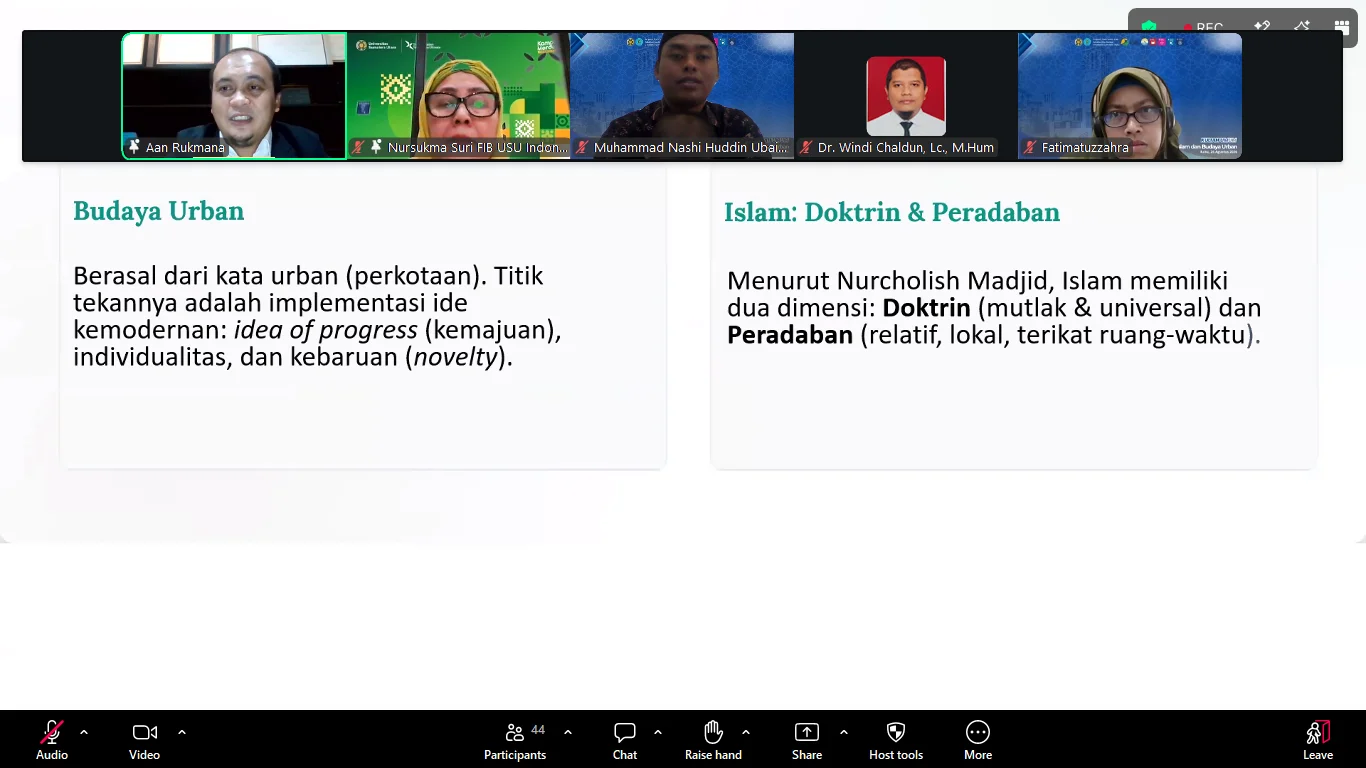
Medan, August 26, 2026 – In an effort to broaden academic horizons, respond to the dynamics of contemporary socio-religious developments, and support the achievement of Quality Education (Sustainable Development Goal 4 / SDG 4), the Arabic Literature Study Program at the Faculty of Cultural Sciences, Universitas Sumatera Utara (FIB USU), successfully organized a national public lecture titled “Islam and Urban Culture” online via Zoom Meeting. This scientific event served as a concrete manifestation of the institution's commitment to providing inclusive, relevant, and globally competitive education. The lecture received an enthusiastic reception from the academic community, attended by approximately 70 participants comprising faculty members, researchers, and active students from the Arabic Literature Study Program at FIB USU.
The series of events began solemnly, presided over by Rahmi Yulida Harahap as the Master of Ceremonies (MC), who led the opening protocol session. The agenda proceeded with the singing of the national anthem, Indonesia Raya, followed by a short video presentation highlighting the institution's profile. The program then moved to its next major agenda item: opening remarks delivered by Dr. Zulfan, S.S., M.Hum., Vice Dean for Academic, Student, and Alumni Affairs at FIB USU, who officially opened the event.
In his opening address, Dr. Zulfan expressed high appreciation for the strategic initiative of the Arabic Literature Study Program in initiating a discourse space relevant to modern developments. He emphasized that hosting this scientific forum directly implements Pillar 4 of the SDGs (Quality Education), wherein humanities scholars—specifically in Arabic and Islamic studies—are called upon not to restrict themselves merely to mastering grammar, linguistics, and classical literary texts. Furthermore, to enhance critical literacy and intellectual capacity among modern students, academics must cultivate a critical awareness of the constellation of Islamic culture as it undergoes continuous reduplication, adaptation, and transformation amidst the rapid currents of modernization and urban culture.
Entering the core session of the academic event, the discussion was professionally moderated by Prof. Dr. Dra. Nursukma Suri, M.Ag. The keynote session featured an expert in Islamic philosophy, Dr. Aan Rukmana, M.A., M.M., a lecturer in Philosophy and Religion at Paramadina University. In a systematic and in-depth academic presentation—as part of enriching the higher education curriculum based on SDG 4—Dr. Aan opened his presentation by outlining the historical entry points of Islamic teachings into the Malay Archipelago (Nusantara). He explained how early Islamic teachings harmoniously intertwined with local values, customs, and indigenous sacred worldviews rooted in Nusantara society.
This process of cross-cultural fertilization, according to Dr. Aan, gave birth to a unique, gentle, and inclusive model of religiosity characterized as Rahmatan Lil ‘Alamin (a mercy to all creation). This academic framework was subsequently linked to a broader intellectual history, reviewing the 1935 Cultural Polemic (Polemik Kebudayaan)—a historic debate between Western-oriented modernization proponents and defenders of Eastern tradition. Dr. Aan connected this historical milestone with the intellectual contributions of Indonesian Islamic reformists such as Nurcholish Madjid, Abdurrahman Wahid (Gus Dur), Ahmad Syafii Maarif, Emha Ainun Nadjib, and Azyumardi Azra, who consistently laid the groundwork for a harmonious synthesis between divine values and modern concepts. This historical overview provided valuable learning material for students to understand religious moderation and universal educational values.
Furthermore, the lecture addressed contemporary sociology of religion by dissecting the emerging phenomenon of "expressive Islam" among urban middle-class society. The presentation mapped concrete urban hijrah communities in Indonesia, such as Shift Pemuda Hijrah in Bandung, Hijrah Fest in Jakarta, the One Day One Juz (ODOJ) movement, and Khalifah Generation. Dr. Aan detailed how religious spaces have shifted from traditional boarding schools (pesantren) and village mosques to corporate mosques, hotel venues, and social media platforms. Transmission of knowledge has similarly shifted from studying classical texts (kitab kuning) based on traditional scholarly lineages (sanad) toward popular Islamic discourses via podcasts and religious influencers. Likewise, religious symbolism has evolved into modern syar'i fashion, commercial aesthetics, halal lifestyle trends, and brand certification.
Beyond sociological and phenomenological aspects, Dr. Aan invited participants to engage in philosophical reflections aimed at developing Higher-Order Thinking Skills (HOTS). He discussed the contrast between modern urban architecture—which tends to focus on profane functions and physical grandiosity—and traditional architecture, which aligns with nature as a manifestation of the Divine. The discussion continued with a mapping of knowledge structures integrating theoretical sciences (meta-physics, logic, physics) and practical sciences (ethics, economics, politics), as well as an esoteric exposition of calligraphy and arabesque art as reflections of the beauty of Tawhid (Oneness of God). Concluding his lecture, Dr. Aan affirmed Malek Bennabi's thesis that Islam in Indonesia holds immense potential to become the future of global Islamic civilization—adaptive, progressive, and harmonious without forfeiting its foundational identity.
Participant enthusiasm peaked during the Q&A session. A range of insightful and rigorous questions emerged from both faculty members and students, addressing topics such as shifts in digital religious authority, the challenge of deepening religious doctrine amidst superficial expressive trends, and efforts to integrate Tawhid principles into modern urban design. The interactive session featured profound, contextual responses from the speaker, exemplifying the active and participatory lifelong learning environment promoted under SDG 4 targets.
The intellectually rich public lecture officially concluded with closing remarks delivered by Dr. Windi Chaldun, Lc., M.Hum., Head of the Arabic Literature Study Program at FIB USU. In his closing statement, Dr. Windi expressed sincere gratitude to the speaker for his illuminating presentation and thanked the organizing committee for executing the event successfully. He reaffirmed the program's commitment to advancing SDG 4 by providing high-quality academic learning environments. He expressed hope that the theoretical and pragmatic insights gained from the lecture would be absorbed by the academic community to serve as foundational material for research, undergraduate thesis work, and scholarly publications within the Arabic Literature Study Program at FIB USU in the future.